A Levels Physics (9702)•9702/12/M/J/23
A Levels Physics (9702) — 9702/12/M/J/23, Question 4
An aircraft travels along a horizontal path. Two of the forces that act horizontally on the aircraft are the thrust of the engines and the force due to the wind. The vector diagram for these forces is shown. Which vector represents the resultant horizontal force acting on the aircraft due to these two forces?
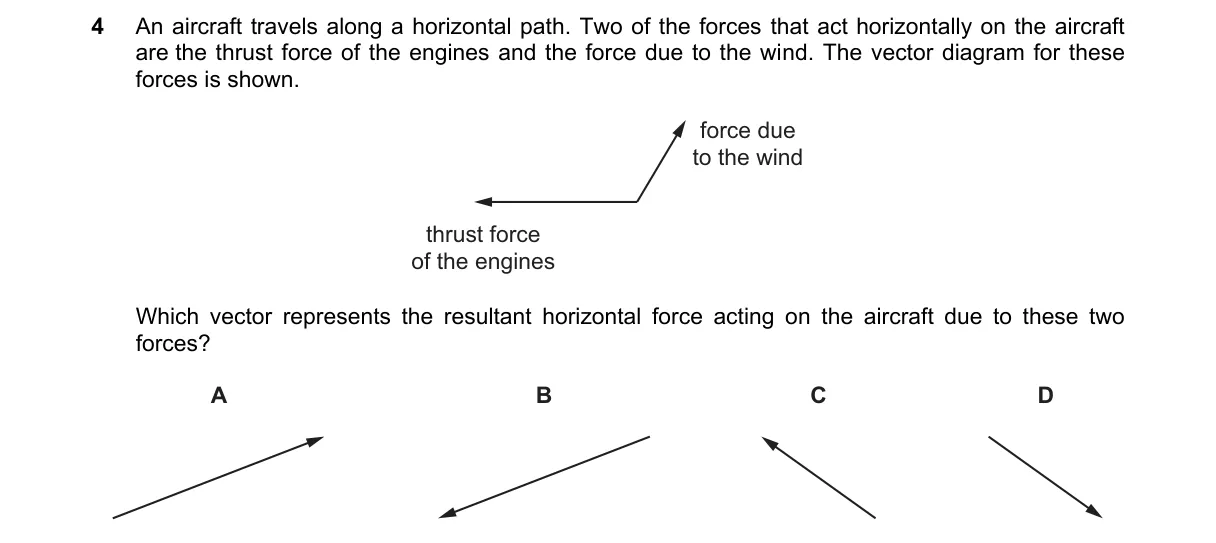
Answer choices
- AOption A
- BOption B
- COption C
- DOption D
Explanation
Resultant Force from Vector Addition
Steps:
- Draw thrust and wind vectors tail-to-tail to form a parallelogram.
- The resultant is the diagonal from the common tail to the opposite corner.
- In the triangle method, place wind vector head-to-tail with thrust; resultant closes the triangle.
- Match the diagram's closing vector to option C.
Why C is correct:
- C represents the vector sum of thrust and wind per the parallelogram law of vector addition.
Why the others are wrong:
- A is the thrust vector alone, ignoring wind.
- B is the wind vector alone, ignoring thrust.
- D is an equilibrium vector (zero resultant), not the sum.
Final answer: C
Topic: Scalars and vectors
Practice more A Levels Physics (9702) questions on mMCQ.me