A Levels Physics (9702)•9702/12/M/J/23
A Levels Physics (9702) — 9702/12/M/J/23, Question 36
Three identical cells each electromotive force (emf) E and negligible internal resistance. The cells are connected to three identical resistors, each resistance R as shown. What is the potential difference across one of the resistors?
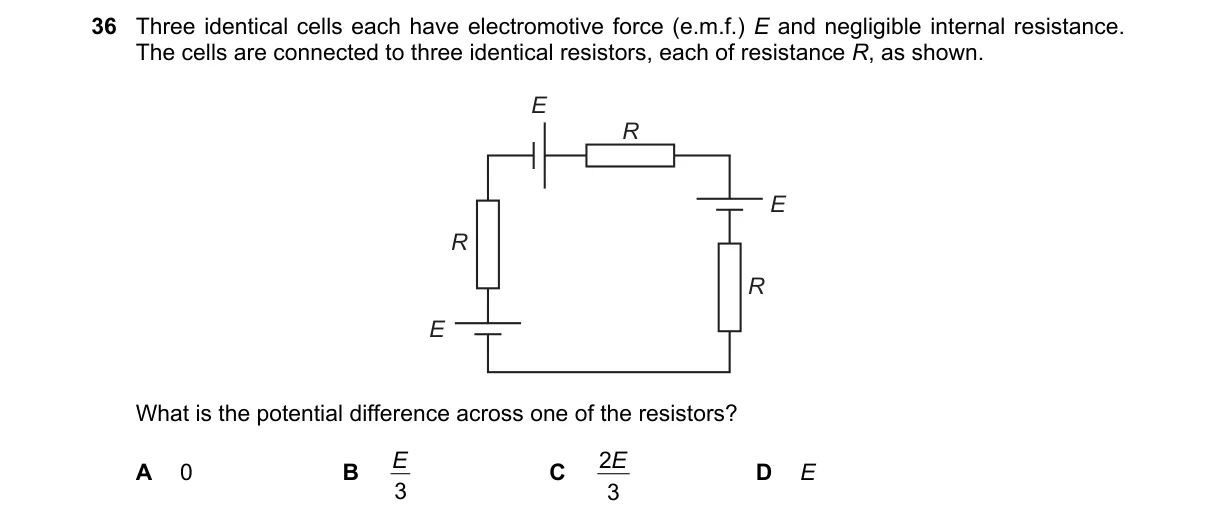
Answer choices
- A0
- BE
- C2E/3
- DE
Explanation
Circuit Configuration Determines Potential Difference Steps:
- Identify the setup: three identical cells (emf E, negligible internal resistance) each connected in series with one identical resistor (resistance R), forming three parallel branches.
- In each branch, the cell drives current through its resistor alone.
- Apply Kirchhoff's voltage law: the potential difference across the resistor equals the emf E, as no other voltage drops occur.
- Thus, the potential difference across any one resistor is E.
Why B is correct:
- The emf E is the open-circuit voltage of the cell, which equals the potential difference across the resistor in a simple series connection with negligible internal resistance (Ohm's law: V = IR, but V = E total).
Why the others are wrong:
- A: 0 implies no voltage source or complete short circuit, not the case here.
- C: 2E/3 suggests voltage division across multiple cells, but each resistor sees one cell.
- D: Duplicate of B (both E), but B is specified as correct.
Final answer: B
Topic: Kirchhoff's laws
Practice more A Levels Physics (9702) questions on mMCQ.me