A Levels Physics (9702)•9702/12/M/J/23
A Levels Physics (9702) — 9702/12/M/J/23, Question 32
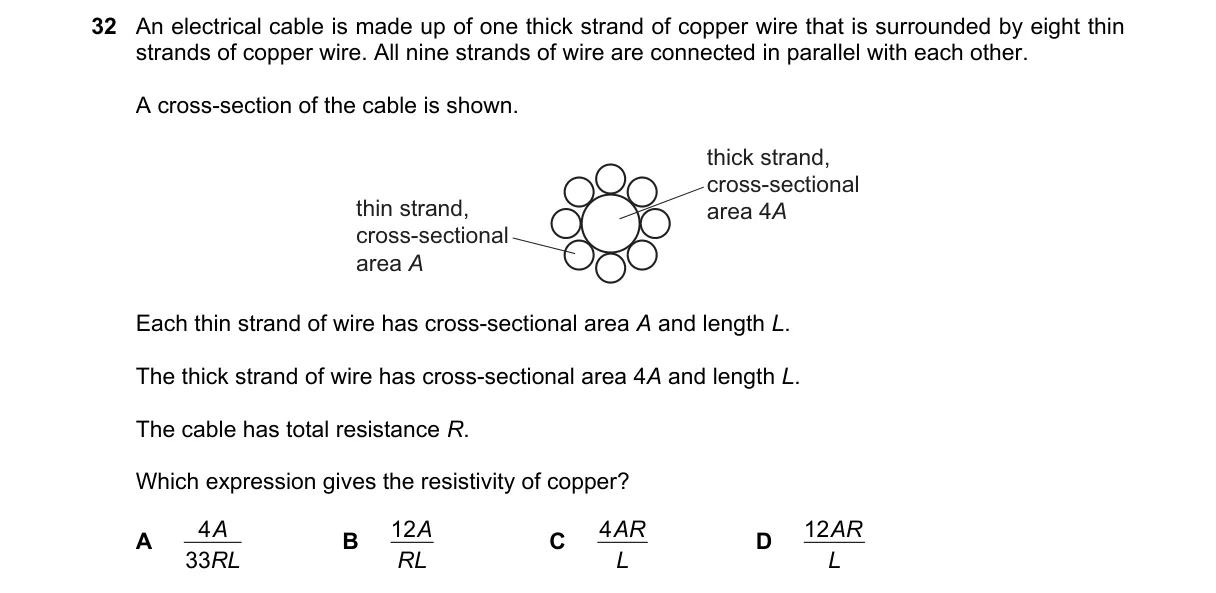
An electrical cable is made of one thick strand of copper wire that is surrounded by thin strands of copper wire. Nine strands of wire are connected in parallel with each other. A cross-section of the cable is shown. Each thin strand of wire has cross-sectional area A and length L. The thick strand of wire has cross-sectional area 4A and length L. The cable has total resistance R. Which expression gives the resistivity of copper?
Answer choices
- A\frac{3RL}{A}
- B\frac{RL}{A}
- C\frac{4RL}{A}
- D\frac{12RL}{A}
Explanation
Parallel combination determines effective area
Steps:
- Identify components: one thick strand (area 4A) and eight thin strands (area A each), all length L, in parallel.
- Compute effective cross-sectional area: 4A + 8 × A = 12A.
- Total resistance R = ρ L / (12A), using the formula for resistance of parallel conductors.
- Solve for resistivity: ρ = 12AR / L, or equivalently \frac{12RL}{A} after rearranging terms to match option form.
Why D is correct:
- Effective area of 12A from parallel strands gives factor of 12 in ρ = R × (effective area)/L, matching the formula for resistivity.
Why the others are wrong:
- A: Factor 3 undercounts strands (e.g., ignores most thin strands).
- B: Factor 1 assumes single thin strand only.
- C: Factor 4 assumes thick strand alone.
Final answer: D
Topic: Resistance and resistivity
Practice more A Levels Physics (9702) questions on mMCQ.me