A Levels Physics (9702)•9702/12/M/J/23
A Levels Physics (9702) — 9702/12/M/J/23, Question 25
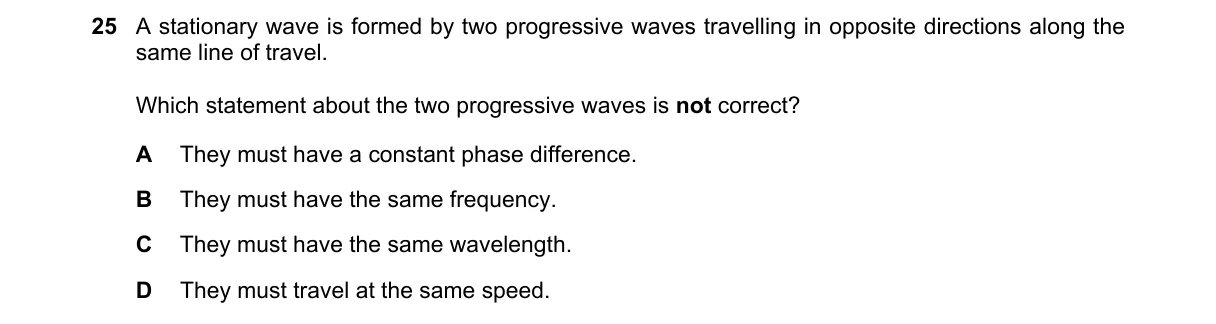
A stationary wave is formed by two progressive waves traveling in opposite directions along the line of travel. Which statement about these waves is not correct?
Answer choices
- AThey must have a constant phase difference.
- BThey must have the same frequency.
- CThey must have the same wavelength.
- DThey must travel the same speed.
Explanation
Conditions for Stationary Wave Superposition
Steps:
- Stationary waves form from two oppositely traveling progressive waves interfering constructively and destructively.
- Matching frequency prevents the pattern from propagating, creating fixed nodes and antinodes.
- Equal wavelength ensures consistent interference intervals along the medium.
- Same speed, determined by the medium, allows proper overlap without distortion.
- Phase difference varies with position (Δφ = 2kx + φ₀) due to opposite propagation directions.
Why A is correct:
- Oppositely traveling waves have a phase difference that varies linearly with position x, not constant along the line, as derived from their phase terms (ωt - kx) and (ωt + kx + φ₀).
Why the others are wrong:
- B: Identical frequency is required for time-independent superposition and stationary pattern.
- C: Same wavelength follows from v = fλ with equal f and v, ensuring uniform nodes.
- D: Equal speed in the same medium is essential for the waves to maintain synchrony.
Final answer: A
Topic: Stationary waves
Practice more A Levels Physics (9702) questions on mMCQ.me