A Levels Physics (9702)•9702/12/M/J/23
A Levels Physics (9702) — 9702/12/M/J/23, Question 22
A source X emits a sound wave of constant frequency f. The wave is subsequently received at a stationary detector Y. The frequency of the wave that is detected by Y is less than f. What is the reason for this?
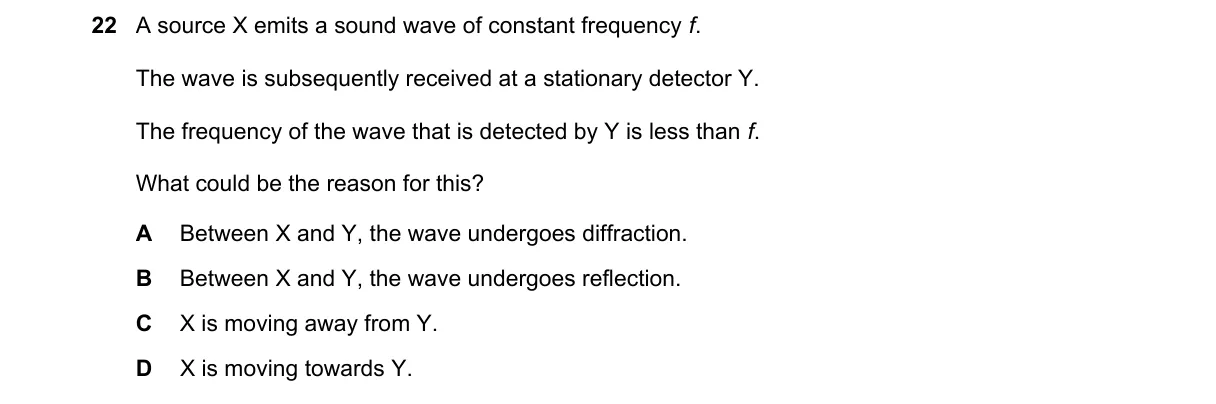
Answer choices
- ABetween X and Y, the wave undergoes diffraction.
- BBetween X and Y, the wave undergoes reflection.
- CX is moving towards Y.
- DX is moving away from Y.
Explanation
Doppler Effect for Sound Waves
Steps:
- The observed frequency change indicates a Doppler shift, where relative motion between source and detector affects the detected frequency.
- For a stationary detector, if the source moves towards it, the detected frequency increases above the emitted f.
- If the source moves away, the detected frequency decreases below f.
- Here, detected frequency < f, so the source must be moving away from the detector.
Why D is correct:
- Doppler formula for source moving away from stationary observer: f' = f / (1 + v_s/c), where v_s is source speed and c is sound speed, yielding f' < f.
Why the others are wrong:
- A: Diffraction bends waves around obstacles but does not change frequency.
- B: Reflection can reverse direction but preserves frequency.
- C: Source moving towards Y would increase frequency via Doppler effect (f' = f / (1 - v_s/c) > f).
Final answer: D
Topic: Doppler effect for sound waves
Practice more A Levels Physics (9702) questions on mMCQ.me