A Levels Physics (9702)•9702/12/M/J/23
A Levels Physics (9702) — 9702/12/M/J/23, Question 21
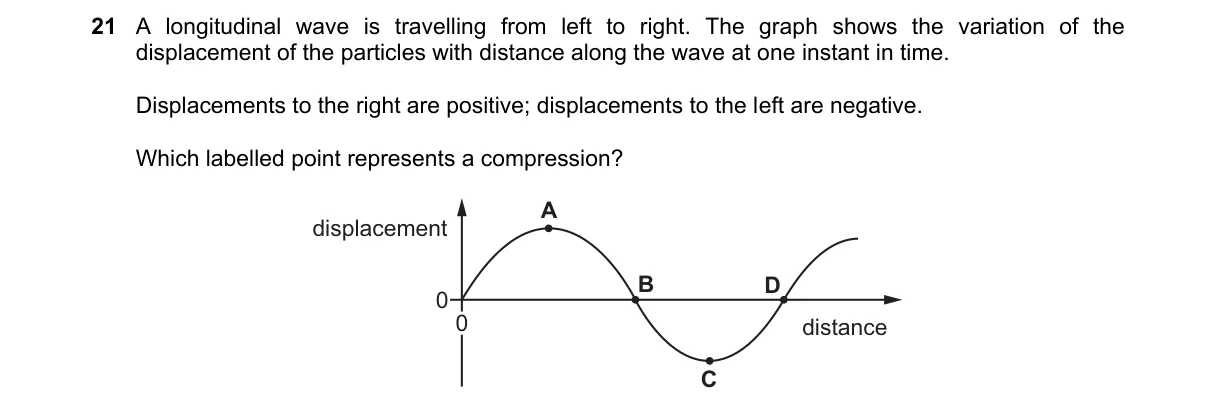
A longitudinal wave is travelling from left to right. The graph shows the variation of the displacement of the particles with distance along the wave at one instant in time. Displacements to the right are positive, displacements to the left are negative. Which labelled point represents a compression?
Answer choices
- AOption A
- BOption B
- COption C
- DOption D
Explanation
Compressions in longitudinal waves occur where the displacement-position graph has a negative slope
Steps:
- Identify the graph: displacement (vertical) vs. distance along wave (horizontal), positive rightward.
- Recall definition: compression where particles bunch up, i.e., slope du/dy < 0 (displacement decreases with position).
- Examine slopes at labelled points: A (positive slope), B (negative slope), C (zero slope), D (positive slope).
- Select point with negative slope as compression.
Why B is correct:
- At B, negative slope means particles ahead have less positive (or more negative) displacement, bunching them closer per wave mechanics.
Why the others are wrong:
- A: Positive slope indicates rarefaction (particles spread out).
- C: Zero slope indicates equilibrium (no compression or rarefaction).
- D: Positive slope indicates rarefaction (particles spread out).
Final answer: B
Topic: Transverse and longitudinal waves
Practice more A Levels Physics (9702) questions on mMCQ.me