A Levels Physics (9702)•9702/11/M/J/23
A Levels Physics (9702) — 9702/11/M/J/23, Question 27
A ripple tank and a barrier with a single gap are used to demonstrate the diffraction of surface waves on water. Initially, the wavelength of the ripples is five times smaller than the gap in the barrier. Which change increases the amount of diffraction observed?
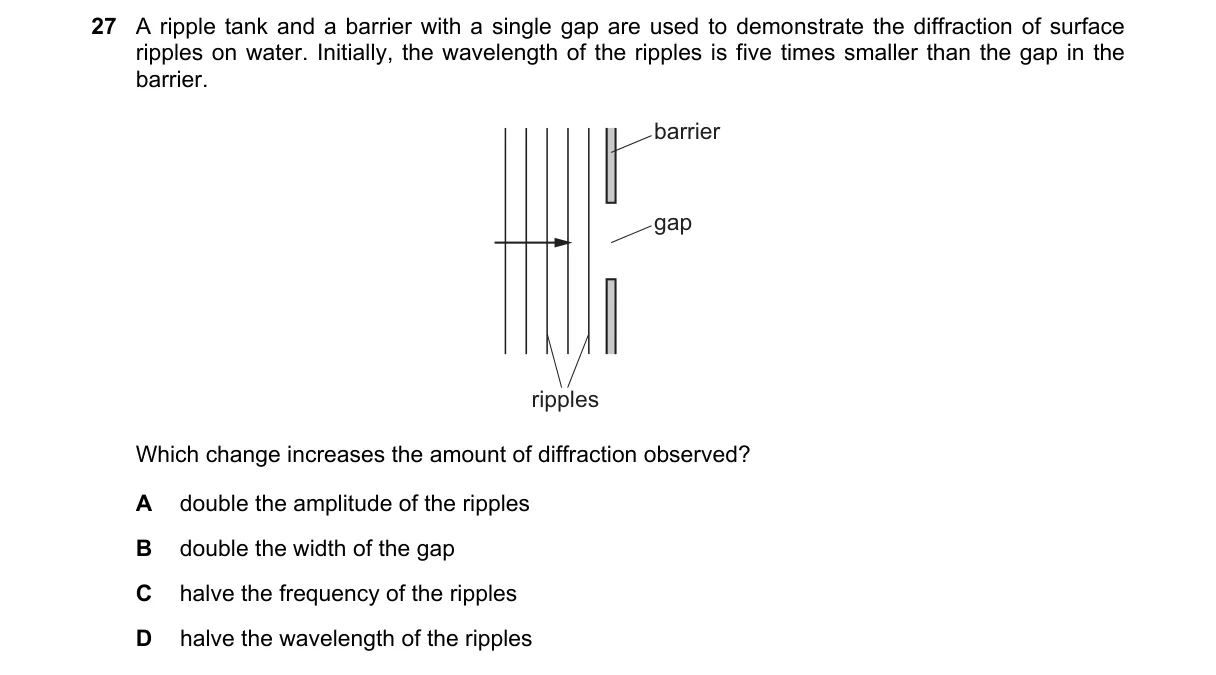
Answer choices
- Adouble the amplitude of the ripples
- Bdouble the width of the gap
- Chalve the frequency of the ripples
- Dhalve the wavelength of the ripples
Explanation
Diffraction maximizes when wavelength nears gap width
Steps:
- Diffraction of waves is significant when wavelength λ is comparable to or larger than gap width d; initially, λ = d/5, so minimal diffraction.
- To increase diffraction, increase the λ/d ratio by enlarging λ relative to d.
- Halving frequency f doubles λ (since wave speed v = fλ is constant on water, λ = v/f).
- This changes λ/d from 1/5 to 2/5, making waves bend more around the barrier.
Why C is correct:
- Halving f doubles λ via v = fλ, raising λ/d and enhancing diffraction per Huygens' principle.
Why the others are wrong:
- A: Amplitude affects wave energy but not diffraction pattern or angle.
- B: Doubles d to 2d, halving λ/d to 1/10, reducing diffraction.
- D: Halves λ to λ/2, doubling λ/d inverse to 1/10, reducing diffraction.
Final answer: C
Topic: Diffraction
Practice more A Levels Physics (9702) questions on mMCQ.me