A Levels Physics (9702)•9702/11/M/J/23
A Levels Physics (9702) — 9702/11/M/J/23, Question 26
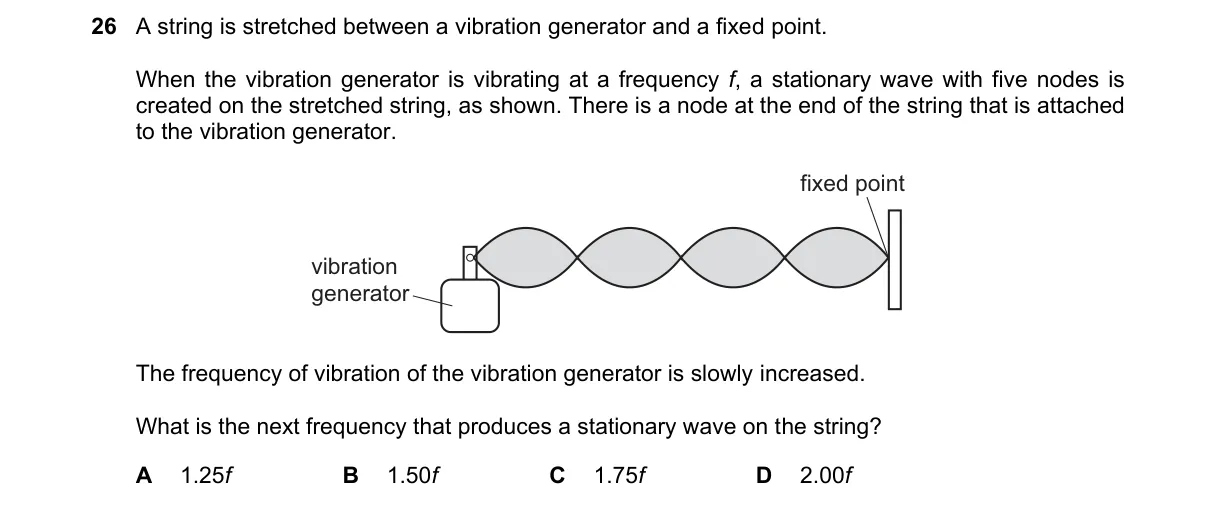
A string is stretched between a vibration generator and a fixed point. When the vibration generator vibrates at a frequency f, a stationary wave with five nodes is created in the stretched string, as shown. There is a node at the end of the string that is attached to the vibration generator. The frequency of vibration of the vibration generator is slowly increased. What is the next frequency that produces a stationary wave on the string?
Answer choices
- A1.5f
- B1.5f
- C1.75f
- D2.00f
Explanation
Standing wave harmonics on a fixed-fixed string Steps:
- Node at both ends means fixed-fixed boundary conditions; wavelengths fit as L = n (λ/2), where n is harmonic number.
- Five nodes imply 4 intervals between nodes, each λ/2 long, so L = 4 (λ/2) = 2λ; thus λ = L/2 and f = v/λ = 2v/L.
- Fundamental f_1 = v/(2L), so current f = 4 f_1 (4th harmonic).
- Vibration generator excites only even harmonics due to driving symmetry; next after 4th is 6th harmonic at 6 f_1 = 1.5 f.
Why A is correct:
- 1.5f matches the 6th harmonic frequency, the next even mode after the current 4th harmonic, per the generator's excitation pattern.
Why the others are wrong:
- B. 1.5f: Identical to A, not a distinct option.
- C. 1.75f: Equals 7 f_1, an odd harmonic not excited by the generator.
- D. 2.00f: Equals 8 f_1, an even harmonic but skips the immediate next (6th).
Final answer: A
Topic: Stationary waves
Practice more A Levels Physics (9702) questions on mMCQ.me