A Levels Physics (9702)•9702/11/M/J/23
A Levels Physics (9702) — 9702/11/M/J/23, Question 20
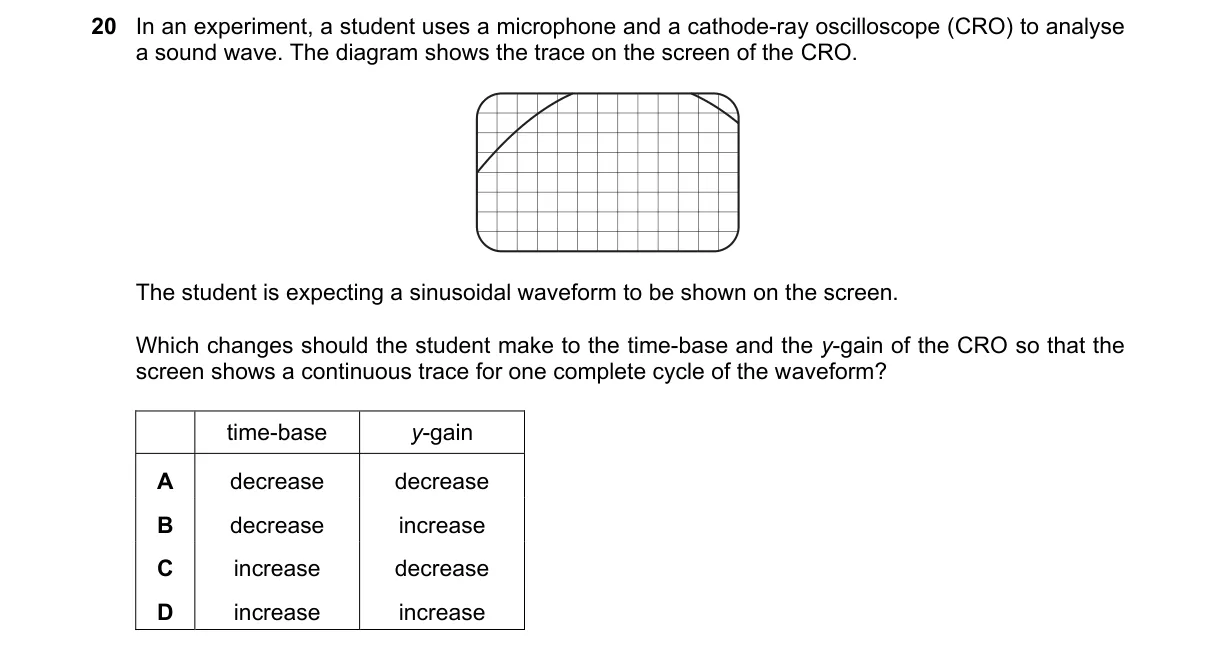
In an experiment, a student uses a microphone and a cathode-ray oscilloscope (CRO) to analyse a sound wave. The diagram shows the trace on the screen of the CRO. The student is expecting a sinusoidal waveform to be shown on the screen. Which changes should the student make to the time base and the y-gain of the CRO so that the screen shows a continuous trace for one complete cycle of the waveform?
Answer choices
- Atime-base: decrease, y-gain: increase
- Btime-base: increase, y-gain: decrease
- Ctime-base: decrease, y-gain: decrease
- Dtime-base: increase, y-gain: increase
Explanation
Adjusting CRO for One Wave Cycle
Steps:
- Determine the waveform's period (time for one cycle) from the sound frequency.
- Increase time base to slow horizontal sweep, expanding the trace to fit exactly one cycle across the screen.
- Assess vertical amplitude; if trace is small, increase y-gain to amplify deflection and fill the screen height.
- Verify sinusoidal shape emerges clearly without distortion.
Why D is correct:
- Increasing time base (s/cm) stretches the horizontal axis per CRO definition, displaying one period; increasing y-gain (V/cm) scales amplitude upward for full visibility.
Why the others are wrong:
- A: Decreasing time base compresses time, showing multiple cycles instead of one.
- B: Increasing time base helps period but decreasing y-gain shrinks amplitude, making trace too small.
- C: Decreasing both compresses time and shrinks amplitude, worsening the display.
Final answer: D
Topic: Progressive waves
Practice more A Levels Physics (9702) questions on mMCQ.me