A Levels Physics (9702)•9702/11/M/J/23
A Levels Physics (9702) — 9702/11/M/J/23, Question 18
A lamp is suspended in equilibrium from a fixed support by three long identical wires. The weight of the lamp causes the middle wire to have an extension of 0.4 cm. The height h of the lamp above the floor is measured. The middle wire suddenly breaks. The wires obey Hooke's law. When the lamp is in equilibrium, the height h of the lamp above the floor is measured again. What is the difference between the two values of h?
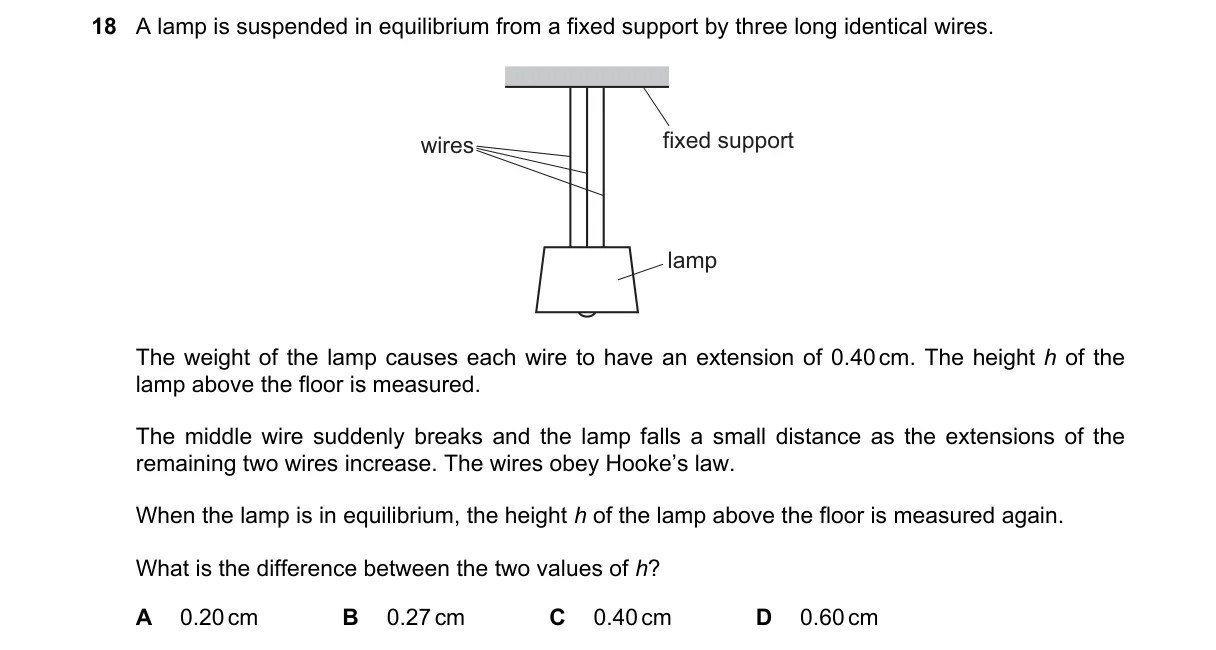
Answer choices
- A0.2 cm
- B0.27 cm
- C0.4 cm
- D0 cm
Explanation
Additional extension in remaining wires due to load redistribution
Steps:
- Initially, three identical wires each support tension W/3 and extend 0.4 cm by Hooke's law.
- After middle wire breaks, two wires each support W/2, so total extension per wire is (W/2)/(W/3) × 0.4 cm = 0.6 cm.
- Additional extension is 0.6 cm - 0.4 cm = 0.2 cm.
- Lamp height h decreases by this additional extension, so difference is 0.2 cm.
Why A is correct:
- Hooke's law states extension ∝ tension; additional tension W/6 per wire causes 0.2 cm extra stretch.
Why the others are wrong:
- B: Incorrect; 0.27 cm unrelated to proportional extension calculation.
- C: Wrong; 0.4 cm ignores that remaining wires start from initial 0.4 cm extension.
- D: Incorrect; equilibrium changes, so height must decrease.
Final answer: A
Topic: Elastic and plastic behaviour
Practice more A Levels Physics (9702) questions on mMCQ.me