A Levels Physics (9702)•9702/11/M/J/23
A Levels Physics (9702) — 9702/11/M/J/23, Question 15
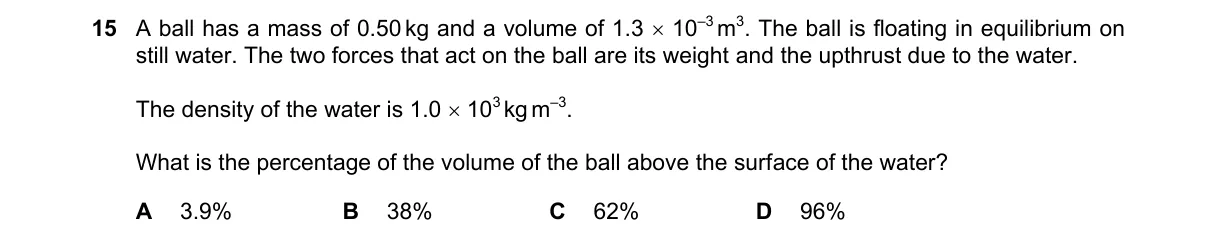
A ball has a mass of 0.5 kg and a volume of 1.3 × 10^{-3} m³. The ball is floating in equilibrium on still water. The density of the water is 1.0 × 10^3 kg m^{-3}. The forces acting on the ball are its weight and the upthrust due to the water. What is the percentage of the volume of the ball above the surface of the water?
Answer choices
- A3%
- B38%
- C62%
- D96%
Explanation
Archimedes' Principle for Floating Objects
Steps:
- Calculate ball's density: ρ_ball = mass / volume = 0.5 kg / 1.3 × 10^{-3} m³ ≈ 385 kg m^{-3}.
- For equilibrium, weight equals upthrust: mg = ρ_water × V_submerged × g, so V_submerged / V_total = ρ_ball / ρ_water.
- Fraction submerged = 385 / 1000 = 0.385 (38.5%).
- Fraction above water = 1 - 0.385 = 0.615 (61.5% ≈ 62%).
Why C is correct:
- 62% matches the unsubmerged volume fraction from Archimedes' principle, where buoyant force equals weight for floating equilibrium.
Why the others are wrong:
- A: 3% confuses unsubmerged with a tiny error in density calculation.
- B: 38% is the submerged fraction, not above water.
- D: 96% inverts the submerged fraction incorrectly.
Final answer: C
Topic: Density and pressure
Practice more A Levels Physics (9702) questions on mMCQ.me