A Levels Physics (9702)•9702/13/M/J/22
A Levels Physics (9702) — 9702/13/M/J/22, Question 3
The drag coefficient, C_d, is a number with no units. It is used to compare the drag on different cars at different speeds. C_d is given by the equation C_d = 2F / (ρ v² A) where F is the drag on the car, v is the speed of the car, ρ is the density of the air, A is the cross-sectional area of the car. What is the value of n?
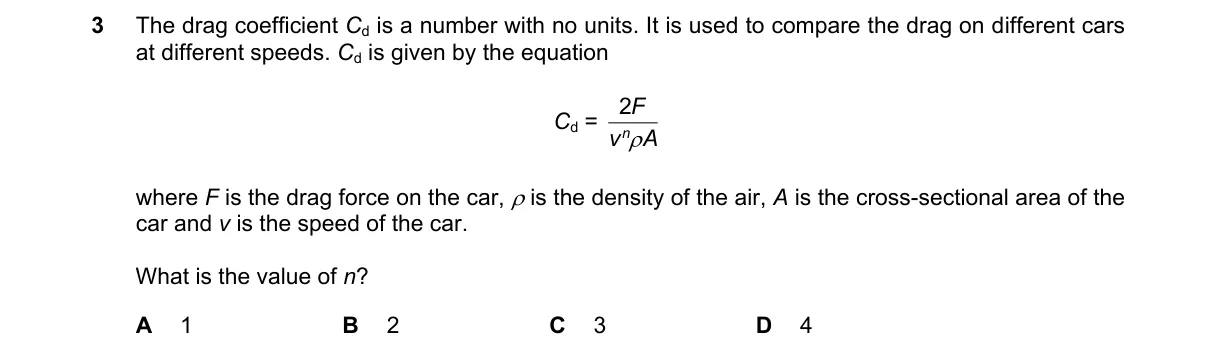
Answer choices
- A1
- B2
- C3
- D4
Explanation
Drag force proportional to speed squared
Steps:
- Rearrange the equation: F = (1/2) C_d ρ v² A.
- C_d is dimensionless and constant for shape comparison.
- For fixed ρ and A, F ∝ v².
- Thus, the exponent n in F ∝ v^n is 2.
Why B is correct:
- The formula shows drag F scales with v², matching the quadratic dependence in aerodynamics.
Why the others are wrong:
- A: Linear dependence (v^1) applies to low-speed viscous drag, not high-speed form drag on cars.
- C: Cubic (v^3) does not appear in standard drag equations.
- D: Quartic (v^4) is unrelated to drag force scaling.
Final answer: B
Topic: Density and pressure
Practice more A Levels Physics (9702) questions on mMCQ.me