A Levels Physics (9702)•9702/13/M/J/22
A Levels Physics (9702) — 9702/13/M/J/22, Question 21
The extension of a copper wire is measured for different forces applied to the wire. A graph is plotted to show the variation of the force on the wire against extension. The maximum force is applied at P. Which statement must be correct?
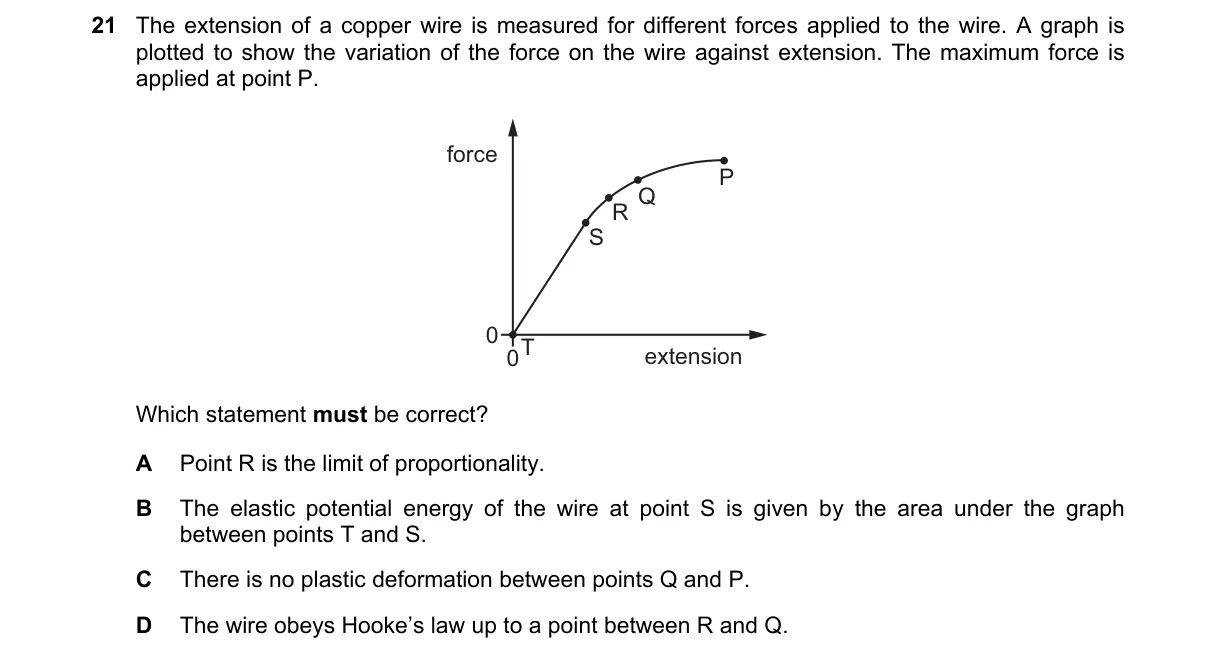
Answer choices
- APoint R is the limit of proportionality.
- BThe elastic potential energy of the wire at point S is given by the area under the graph
- CThere is no plastic deformation between points Q and P.
- DThe wire obeys Hooke's law up to a point between R and Q.
Explanation
Elastic potential energy from force-extension graph
Steps:
- Identify the graph as force (F) versus extension (x), where area under curve represents work done by force.
- Recall that for elastic deformation, work done stores as elastic potential energy (½kx² or integral F dx).
- At point S, area under graph up to S gives total elastic PE if within elastic limit.
- Verify other options contradict standard wire behavior: proportionality ends at straight-line limit, plastic deformation follows.
Why B is correct:
- Elastic potential energy equals work done by applied force, which is the area under the F-x graph (from definition of work as ∫F dx).
Why the others are wrong:
- A: Limit of proportionality is end of straight line, likely before R if R follows deviation.
- C: Between Q (likely yield point) and P (max force), plastic deformation occurs as extension continues without full recovery.
- D: Hooke's law (F ∝ x) holds only up to proportionality limit, not beyond into R-Q region.
Final answer: B
Topic: Elastic and plastic behaviour
Practice more A Levels Physics (9702) questions on mMCQ.me