A Levels Physics (9702)•9702/12/M/J/22
A Levels Physics (9702) — 9702/12/M/J/22, Question 38
In an experiment on α-particle scattering, α-particles are directed at a thin gold foil. Most of the α-particles pass straight through the foil or are deflected by a small angle. A small number of α-particles are deflected by a large angle. Which statement cannot be deduced from this experiment?
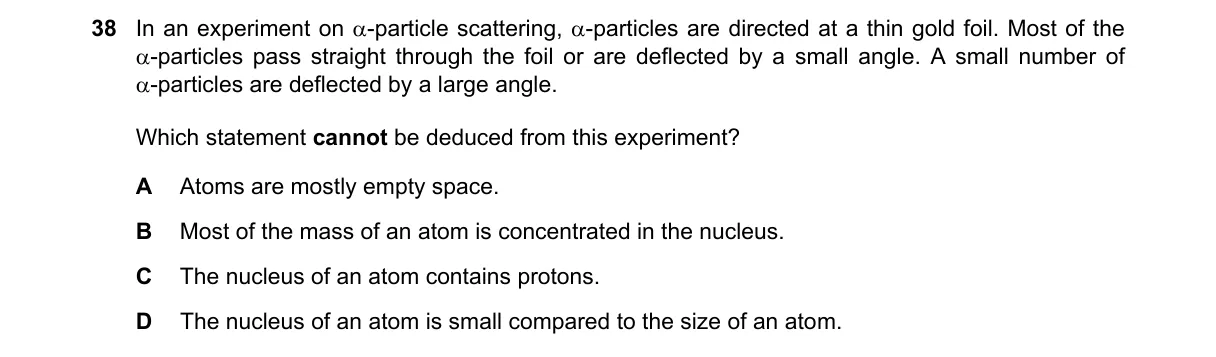
Answer choices
- AMost of the mass of an atom is concentrated in the nucleus.
- BThe nucleus of an atom contains protons.
- CThe nucleus of an atom is small compared to the size of an atom.
- DOption D
Explanation
Rutherford's Gold Foil Experiment Deductions Steps:
- Most α-particles pass undeflected, showing atoms consist mostly of empty space.
- Small-angle deflections result from interactions with diffuse electrons.
- Rare large-angle deflections occur from close encounters with a dense, positively charged core.
- The experiment infers a positive nucleus but reveals no details on its substructure.
Why C is correct:
- The 1911 experiment shows nuclear positive charge via α-particle repulsion but does not identify protons, discovered later through hydrogen nucleus studies.
Why the others are wrong:
- A: Large deflections of massive α-particles demand concentrated mass in the nucleus for significant momentum transfer.
- B: Low frequency of large scatters implies the nucleus has a tiny cross-sectional area relative to the atom.
- D: Not enough information.
Final answer: C
Topic: Atoms, nuclei and radiation
Practice more A Levels Physics (9702) questions on mMCQ.me