A Levels Physics (9702)•9702/12/M/J/22
A Levels Physics (9702) — 9702/12/M/J/22, Question 24
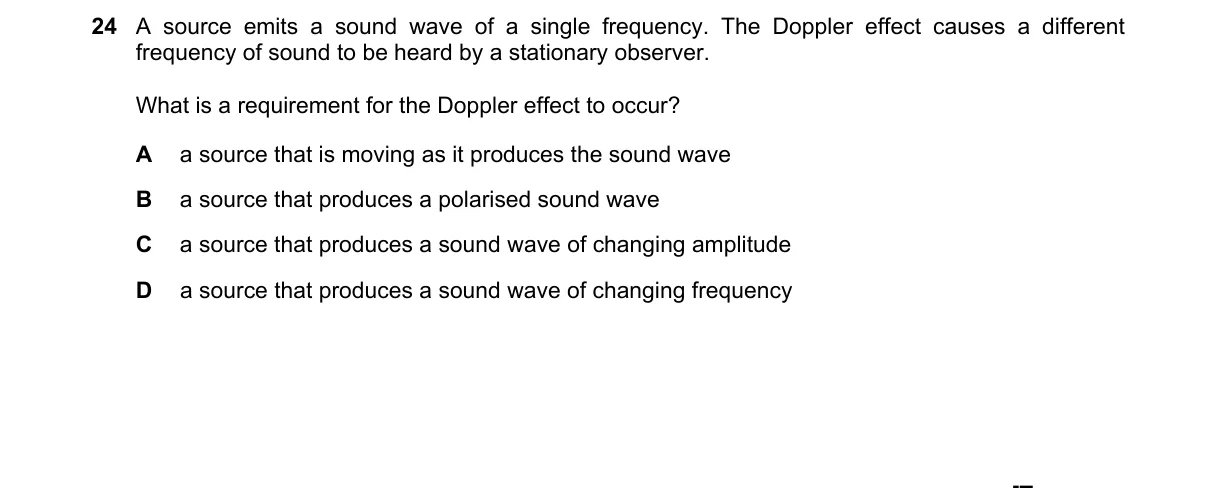
A source emits a sound wave of a single frequency. The Doppler effect causes a different frequency to be heard by a stationary observer. What is required for the Doppler effect?
Answer choices
- Aa source that is moving as it produces the sound wave
- Ba source that produces a polarized sound wave
- Ca source that produces a sound wave of changing amplitude
- Da source that produces a sound wave of changing frequency
Explanation
Doppler Effect Requires Relative Motion
Steps:
- Identify Doppler effect as frequency shift in waves due to relative motion between source and observer.
- Note the observer is stationary, so motion must come from the source for sound waves in a medium.
- Eliminate options unrelated to motion: polarization, amplitude changes, or inherent frequency variation.
- Confirm A directly states source motion, matching the effect's cause.
Why A is correct:
- Doppler formula for sound, , derives frequency change from source speed relative to medium speed .
Why the others are wrong:
- B: Sound waves are longitudinal, incapable of polarization like transverse electromagnetic waves.
- C: Amplitude variation modulates intensity, not frequency, producing no Doppler shift.
- D: Inherent frequency changes indicate modulation, not motion-induced Doppler effect.
Final answer: A
Topic: Doppler effect for sound waves
Practice more A Levels Physics (9702) questions on mMCQ.me