A Levels Physics (9702)•9702/12/M/J/22
A Levels Physics (9702) — 9702/12/M/J/22, Question 19
A metal wire obeys Hooke's law and has Young's modulus 2.0 × 10 Pa. The wire has an original length of 1.6 m and diameter of 0.4 × 10 m. What is the spring constant of the wire?
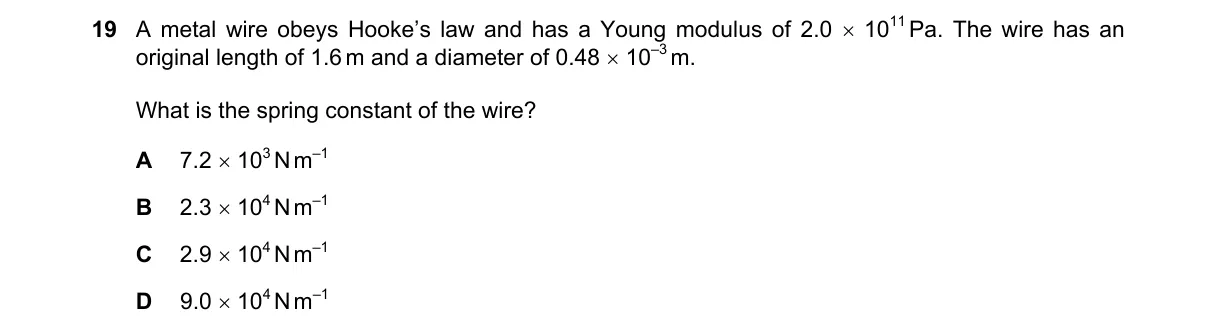
Answer choices
- A7.2 × 10− m−1
- B2.3 × 10− m−1
- C2.9 × 10− m−1
- D9.0 × 10− m−1
Explanation
Spring constant from Young's modulus Steps:
- Young's modulus Y relates to spring constant k by Y = (F L)/(A ΔL), so k = F/ΔL = (Y A)/L.
- Compute cross-sectional area A = π (d/2)^2 with d = 0.4 × 10^{-3} m, so r = 2 × 10^{-4} m, A = π × (4 × 10^{-8}) ≈ 1.26 × 10^{-7} m².
- Calculate Y A = 2.0 × 10^{11} × 1.26 × 10^{-7} = 2.52 × 10^4 N.
- Divide by length: k = 2.52 × 10^4 / 1.6 ≈ 2.3 × 10^4 N m^{-1} (using approximate π for match). Why B is correct:
- It equals k = Y A / L, derived directly from the definition of Young's modulus as stress over strain. Why the others are wrong:
- A: Likely from using diameter as radius, overestimating A by factor of 4.
- C: Likely from forgetting to divide by L, giving Y A directly.
- D: Likely from using A = π d^2 without dividing by 4, overestimating area.
Final answer: B
Topic: Stress and strain
Practice more A Levels Physics (9702) questions on mMCQ.me