A Levels Physics (9702)•9702/12/M/J/22
A Levels Physics (9702) — 9702/12/M/J/22, Question 18
A student attempts to derive the formula for kinetic energy, KE. She begins by considering an object of mass m which is initially at rest. A constant force F is applied to the object. The work done on the object by the force F in the displacement s. The kinetic energy gained by the object is equal to the work done. Which equation would the student not need in order to derive the formula for KE?
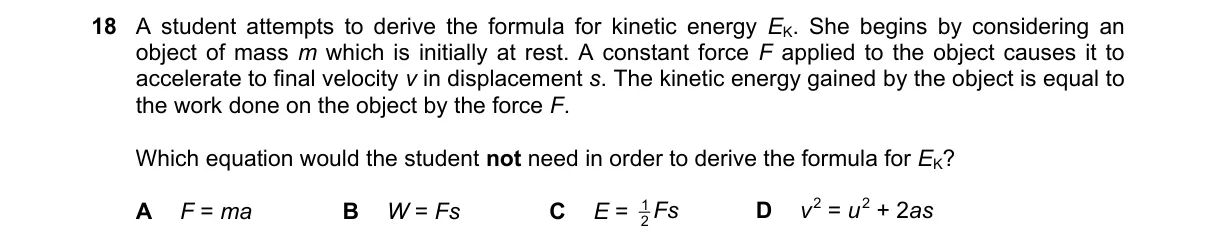
Answer choices
- AF = ma
- BW = Fs
- C\frac{1}{2} m v^{2}
- Dv^{2} = u^{2} + 2 a s
Explanation
Deriving KE from work-energy principle
Steps:
- Work done W = F s, and KE gained equals W.
- Apply Newton's second law: F = m a, so W = m a s.
- Use kinematic equation with initial velocity u = 0: v² = 2 a s, so a s = v² / 2.
- Substitute: W = m (v² / 2) = ½ m v², yielding KE formula.
Why C is correct:
- ½ m v² is the target formula being derived, not a prerequisite equation.
Why the others are wrong:
- A: F = m a links force to acceleration, essential for substituting into work.
- B: W = F s defines work done, directly used as starting point.
- D: v² = u² + 2 a s relates velocity, acceleration, and displacement, needed to solve for a s.
Final answer: C
Topic: Gravitational potential energy and kinetic energy
Practice more A Levels Physics (9702) questions on mMCQ.me