A Levels Physics (9702)•9702/11/M/J/22
A Levels Physics (9702) — 9702/11/M/J/22, Question 36
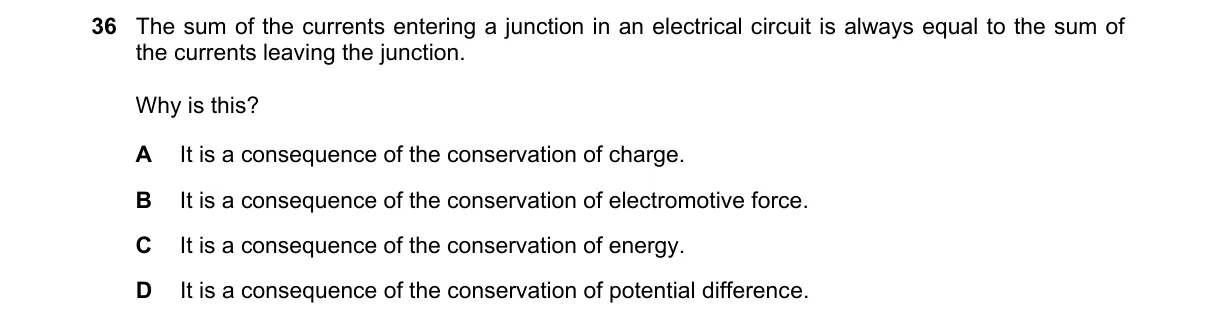
The sum of the currents entering a junction in an electrical circuit is always equal to the sum of the currents leaving the junction. Why is this?
Answer choices
- AIt is a consequence of the conservation of charge.
- BIt is a consequence of the conservation of electromotive force.
- CIt is a consequence of the conservation of energy.
- DIt is a consequence of the conservation of potential difference.
Explanation
Kirchhoff's Current Law and Charge Conservation
Steps:
- Charge is neither created nor destroyed in a circuit junction.
- Incoming currents bring positive charge at a rate equal to their sum.
- Outgoing currents remove positive charge at a rate equal to their sum.
- For no charge buildup, incoming charge rate equals outgoing charge rate, so currents balance.
Why A is correct:
- Conservation of charge states that total charge in an isolated system remains constant; at a junction, net charge flow must be zero, leading to ∑I_in = ∑I_out (Kirchhoff's Current Law).
Why the others are wrong:
- B: Electromotive force (EMF) is the voltage provided by sources, not a conserved quantity dictating current balance.
- C: Conservation of energy relates to power dissipation and Kirchhoff's Voltage Law, not junction currents.
- D: Potential difference is voltage drop across components, unrelated to current summation at junctions.
Final answer: A
Topic: Kirchhoff's laws
Practice more A Levels Physics (9702) questions on mMCQ.me