A Levels Physics (9702)•9702/11/M/J/22
A Levels Physics (9702) — 9702/11/M/J/22, Question 24
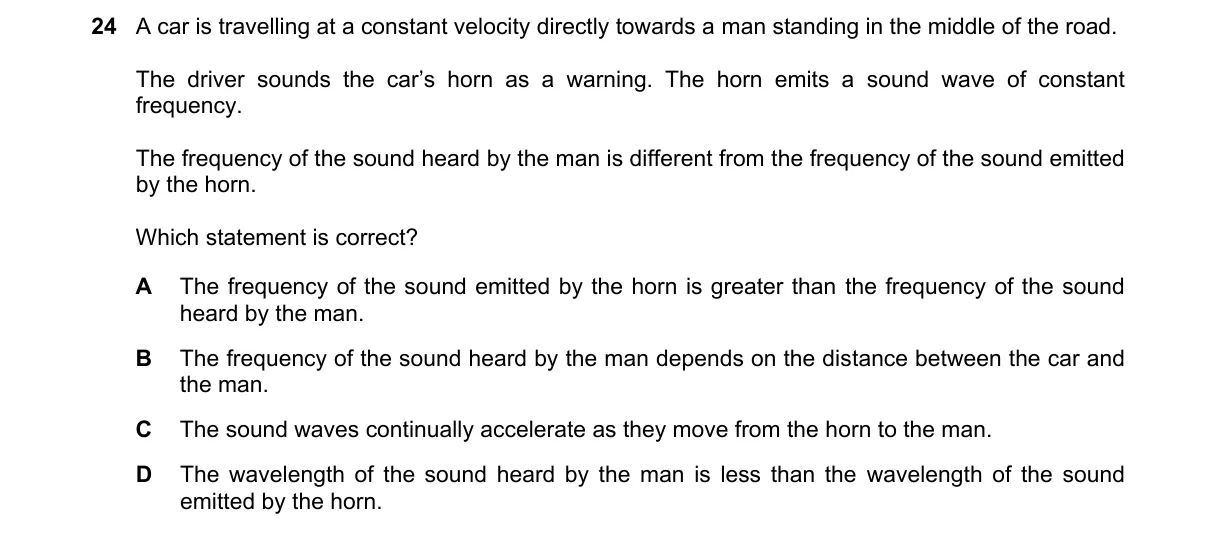
A car is traveling at constant velocity directly towards a man standing in the middle of the road. The driver sounds the car's horn as a warning. The horn emits a sound wave of constant frequency. The frequency of the sound heard by the man is different from the frequency of the sound emitted by the horn. Which statement is correct?
Answer choices
- AThe frequency of the sound emitted by the horn is greater than the frequency of the sound heard by the man.
- BThe frequency of the sound heard by the man depends on the distance between the car and the man.
- CThe sound waves continually accelerate as they move from the horn.
- DThe wavelength of the sound heard by the man is less than the wavelength of the sound emitted by the horn.
Explanation
Doppler Effect for Approaching Source
Steps:
- Identify the scenario: source (horn) moves toward stationary observer (man) at constant velocity.
- Recall Doppler formula: observed frequency , where is emitted frequency, is sound speed, is source speed (positive toward observer).
- Since , ; higher frequency means shorter wavelength ().
- Conclude wavelength heard is shorter.
Why D is correct:
- For approaching source, waves compress, reducing wavelength while increasing frequency, per Doppler principle.
Why the others are wrong:
- A: Incorrect; heard frequency exceeds emitted frequency due to bunching of waves.
- B: Incorrect; frequency is constant for steady velocity, independent of distance.
- C: Incorrect; sound waves travel at constant speed ; no acceleration occurs.
Final answer: D
Topic: Doppler effect for sound waves
Practice more A Levels Physics (9702) questions on mMCQ.me