A Levels Physics (9702)•9702/11/M/J/22
A Levels Physics (9702) — 9702/11/M/J/22, Question 14
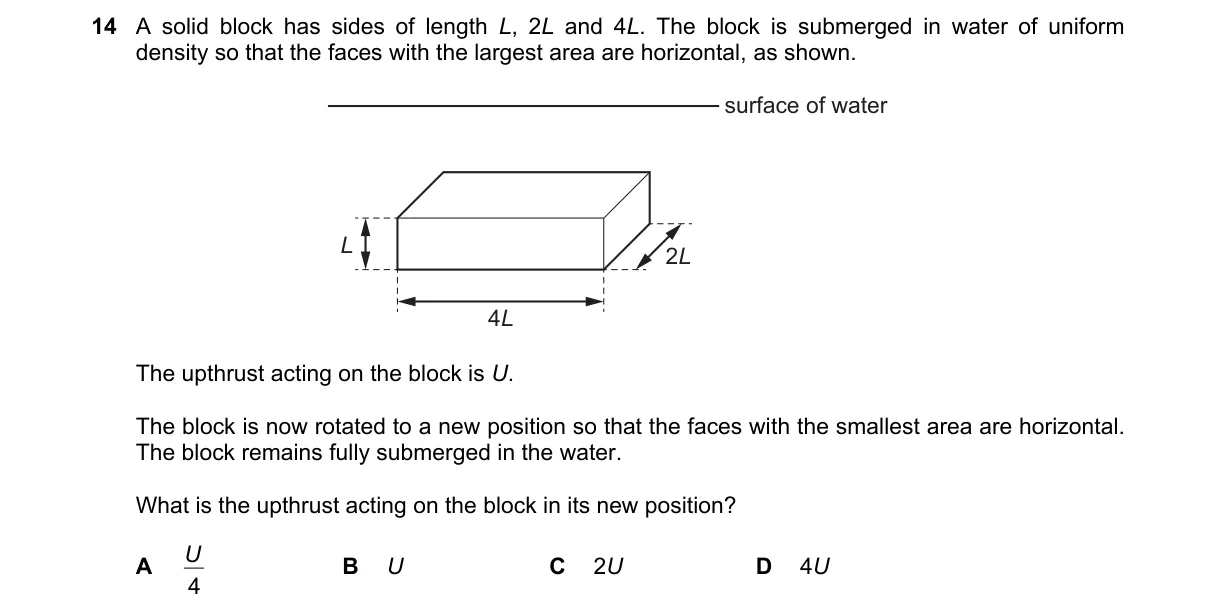
A solid block has sides of length L, 2L and 4L. The block is submerged in water of uniform density so that the faces with the largest area are horizontal, as shown. The upthrust on the block is U. The block is now rotated to a new position so that the faces with the smallest area are horizontal. What is the upthrust on the block in its new position?
Answer choices
- AU/4
- BU
- C2U
- D4U
Explanation
Archimedes' principle: upthrust equals weight of displaced fluid
Steps:
- Volume of block is L × 2L × 4L = 8L³, fully submerged both times.
- Initial upthrust U = ρ g × 8L³, where ρ is water density.
- Rotation changes orientation but not submerged volume.
- New upthrust = ρ g × 8L³ = U.
Why B is correct:
- Upthrust depends solely on displaced volume per Archimedes' principle, unchanged by rotation.
Why the others are wrong:
- A: Confuses upthrust with base area ratio (smallest to largest is 1/4).
- C: Assumes upthrust doubles with height change, but volume is fixed.
- D: Assumes upthrust quadruples inversely with base area, ignoring volume.
Final answer: B
Topic: Density and pressure
Practice more A Levels Physics (9702) questions on mMCQ.me