A Levels Physics (9702)•9702/13/M/J/21
A Levels Physics (9702) — 9702/13/M/J/21, Question 36
The circuit shown includes a cell of constant internal resistance and an external resistor R. A student records the ammeter and voltmeter readings, She then connects a second identical external resistor in parallel with the first external resistor. What happens to the ammeter reading and the voltmeter reading?
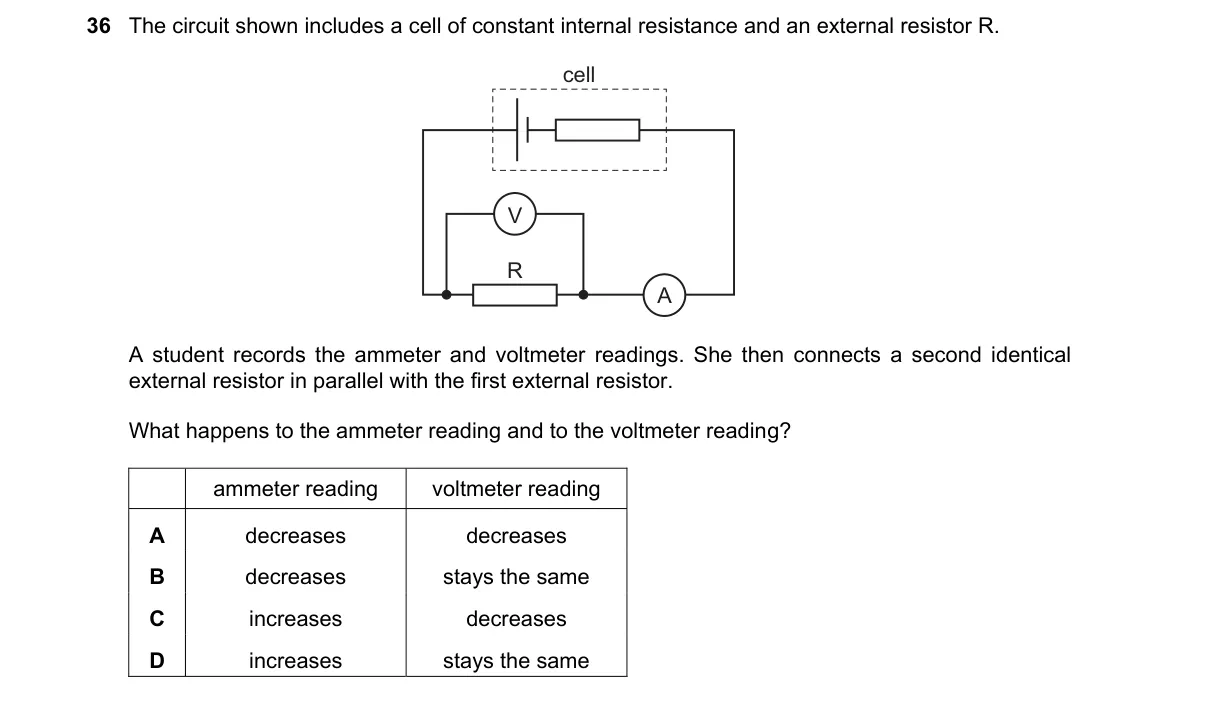
Answer choices
- Adecreases decreases
- Bdecreases stays the same
- Cincreases decreases
- Dincreases stays the same
Explanation
Parallel Resistors Alter Total Current and Terminal Voltage
Steps:
- Initial setup: Total resistance is internal r plus external R; current I = E/(r + R); voltmeter reads V = I × R across R.
- Adding identical R in parallel: Equivalent external resistance becomes R/2; total resistance decreases to r + R/2.
- Current increases: Smaller total resistance raises I to E/(r + R/2), so ammeter reading increases.
- Voltage decreases: New V = I × (R/2) = E × (R/2)/(r + R/2); larger effective denominator (2r + R) compared to original (r + R) lowers V.
Why C is correct:
- Ohm's law: Reduced total resistance increases current; more voltage drops across internal r, decreasing terminal voltage across external resistors (V = E × Req/(r + Req), where Req halves).
Why the others are wrong:
- A: Voltmeter decreases correctly, but ammeter increases, not decreases.
- B: Ammeter increases, not decreases; voltmeter decreases, not stays the same.
- D: Voltmeter decreases, not stays the same.
Final answer: C
Topic: Practical circuits
Practice more A Levels Physics (9702) questions on mMCQ.me