A Levels Physics (9702)•9702/13/M/J/21
A Levels Physics (9702) — 9702/13/M/J/21, Question 27
To produce a stationary wave, two waves must travel in opposite directions through the same space.
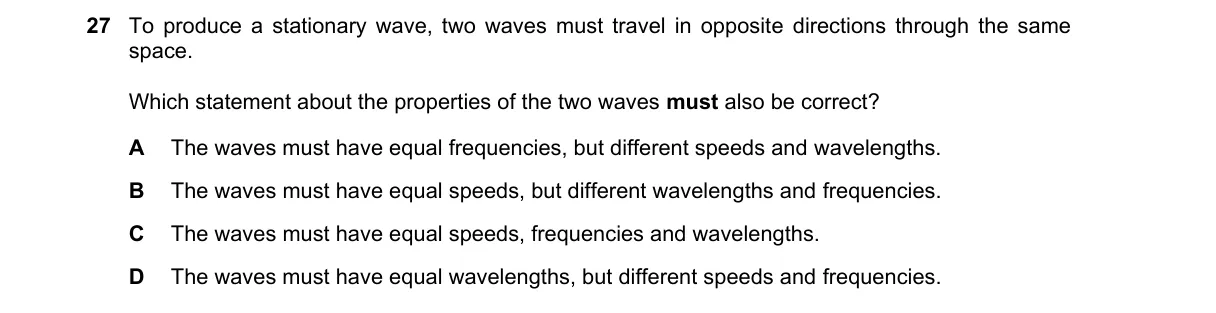
Answer choices
- AThe waves must have equal frequencies, but different speeds and wavelengths.
- BThe waves must have equal speeds, different frequencies and wavelengths.
- CThe waves must have equal speeds, frequencies and wavelengths.
- DThe waves must have equal wavelengths, but different speeds and frequencies.
Explanation
Conditions for Forming Standing Waves
Steps:
- Stationary waves form from superposition of two waves traveling in opposite directions.
- For constructive and destructive interference to create nodes and antinodes, waves must match in key properties.
- Equal frequencies ensure interference patterns remain fixed in space.
- Equal speeds and wavelengths guarantee phase consistency and prevent pattern drift.
Why C is correct:
- Standing waves require identical speeds, frequencies, and wavelengths for perfect superposition, as per the wave interference principle where the resultant wave amplitude is stationary.
Why the others are wrong:
- A: Different speeds cause varying phase velocities, preventing fixed nodes.
- B: Different frequencies lead to beating, not stationary patterns.
- D: Different speeds and frequencies disrupt consistent interference.
Final answer: C
Topic: Stationary waves
Practice more A Levels Physics (9702) questions on mMCQ.me