A Levels Physics (9702)•9702/13/M/J/21
A Levels Physics (9702) — 9702/13/M/J/21, Question 25
A train's whistle emitting sound frequency 500 Hz the train moves with speed 20 ms^{-1} along a straight track. The train moves directly towards a station observer standing next to the track and then passes the observer. The speed of sound in air is 330 ms^{-1}. What is the difference in frequencies of the sound by the observer before and after the train passes the observer?
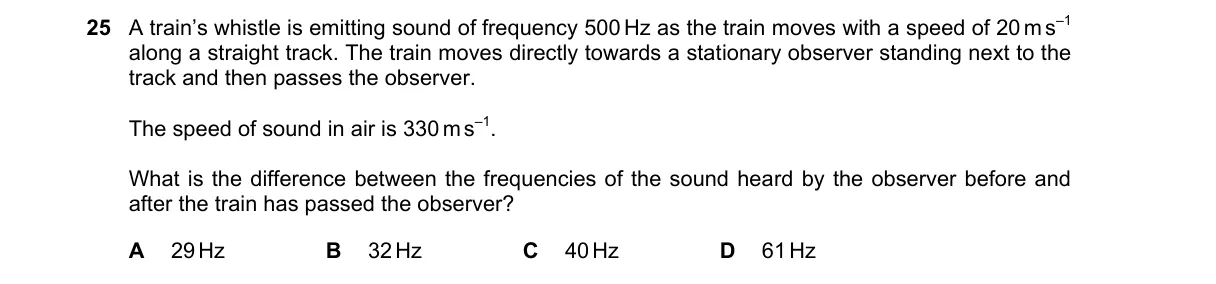
Answer choices
- A29 Hz
- B32 Hz
- C40 Hz
- D61 Hz
Explanation
Doppler Effect for Approaching and Receding Source
Steps:
- Frequency before passing (approaching): Hz
- Frequency after passing (receding): Hz
- Difference: Hz
- Matches option D
Why D is correct:
- The 61 Hz difference follows directly from the Doppler formula for a moving source and stationary observer, .
Why the others are wrong:
- A: Underestimates shift; ignores full Doppler ratio, uses rough approximation Hz.
- B: Similar approximation error, possibly rounding incorrectly.
- C: Arithmetically close but wrong; likely miscalculates as 1.06 instead of 1.065.
Final answer: D
Topic: Doppler effect for sound waves
Practice more A Levels Physics (9702) questions on mMCQ.me