A Levels Physics (9702)•9702/13/M/J/21
A Levels Physics (9702) — 9702/13/M/J/21, Question 17
A sample of gas is sealed in a cylinder piston. Friction piston free to move, so that the pressure of the gas remains constant at 1.0 × 10 Pa. The gas initially occupies a volume of 2.0 × 10^{-3} m³. The gas does 4.0 J of work. What is the volume of the gas after doing this work?
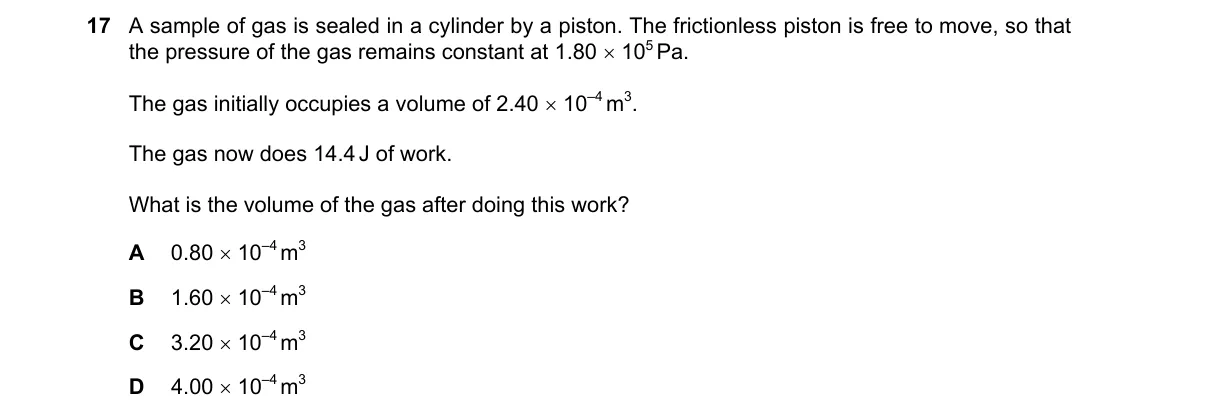
Answer choices
- A0.80 × 10^{-3} m³
- B1.60 × 10^{-3} m³
- C3.20 × 10^{-3} m³
- D4.00 × 10^{-3} m³
Explanation
Isobaric expansion work
Steps:
- Identify the process as isobaric since pressure remains constant as the piston moves freely.
- Apply the formula for work done by the gas: W = P (V_f - V_i).
- Solve for final volume: V_f = V_i + W / P.
- Substitute values to find V_f = 3.20 × 10^{-3} m³.
Why C is correct:
- It matches V_f = V_i + W / P from the first law for constant-pressure expansion.
Why the others are wrong:
- A is smaller than initial volume, implying compression where gas cannot do positive work.
- B is also smaller than initial volume, implying compression.
- D overestimates the volume change, exceeding the calculated ΔV = W / P.
Final answer: C
Topic: The first law of thermodynamics
Practice more A Levels Physics (9702) questions on mMCQ.me