A Levels Physics (9702)•9702/13/M/J/21
A Levels Physics (9702) — 9702/13/M/J/21, Question 11
A steel ball at constant terminal speed in air. The forces acting on the ball are thrust, viscous drag and weight. What is the order of increasing magnitude of these three forces?
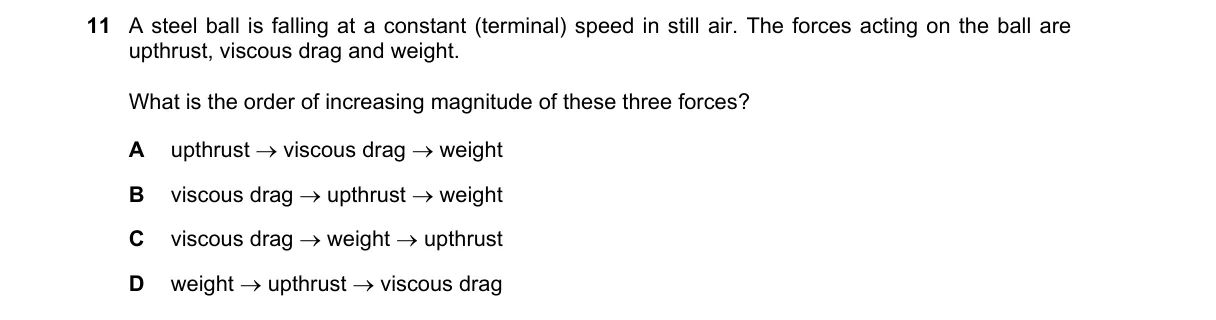
Answer choices
- Athrust - viscous drag - weight
- Bviscous drag - thrust - weight
- Cviscous drag - weight - thrust
- Dweight - thrust - viscous drag
Explanation
Force balance at terminal velocity including buoyancy
Steps:
- At constant terminal speed, net force is zero: weight = viscous drag + thrust (upthrust/buoyancy).
- Weight acts downward; viscous drag and thrust act upward, opposing motion.
- For a steel ball in air, thrust (buoyant force) is negligible: thrust ≈ weight × (air density / steel density) ≈ 0.00015 × weight.
- Thus, viscous drag ≈ weight, so thrust < viscous drag < weight.
Why A is correct:
- Weight balances the sum of thrust and drag; buoyant thrust is tiny in air, making drag nearly equal to weight.
Why the others are wrong:
- B: Places viscous drag smallest, but drag dominates to balance weight.
- C: Places weight between drag and thrust, but weight is always largest.
- D: Places weight smallest, contradicting force balance where weight equals sum of others.
Final answer: A
Topic: Equilibrium of forces
Practice more A Levels Physics (9702) questions on mMCQ.me