A Levels Physics (9702)•9702/12/M/J/21
A Levels Physics (9702) — 9702/12/M/J/21, Question 26
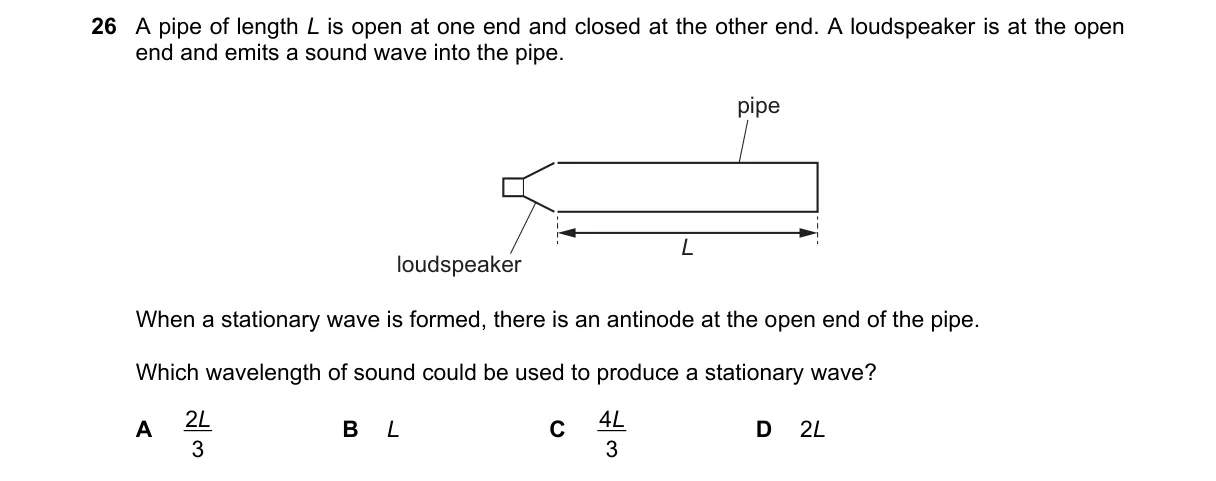
A pipe of length L is open at one end and closed at the other end. A loudspeaker at the open end emits sound waves into the pipe. When a stationary wave is formed, there is an antinode at the open end of the pipe. Which wavelength of sound could be used to form a stationary wave?
Answer choices
- A2L/3
- BL
- C4L/3
- D2L
Explanation
Standing waves in a closed-open pipe
Steps:
- Boundary conditions require a node at the closed end and an antinode at the open end.
- Pipe length L equals an odd multiple of quarter-wavelengths: L = (2n-1)λ/4, where n=1,2,3,...
- Rearrange for wavelength: λ = 4L/(2n-1).
- For n=2, λ=4L/3, matching option C.
Why C is correct:
- λ=4L/3 is the first overtone (n=2) for a closed pipe, satisfying the node-antinode conditions.
Why the others are wrong:
- A: 2L/3 implies even multiple of λ/4, violating odd-quarter rule for closed pipes.
- B: L implies L=λ, or four quarter-waves (even multiple), not possible.
- D: 2L implies L=λ/2, or half-wave, incompatible with closed-end node.
Final answer: C
Topic: Stationary waves
Practice more A Levels Physics (9702) questions on mMCQ.me