A Levels Physics (9702)•9702/12/M/J/21
A Levels Physics (9702) — 9702/12/M/J/21, Question 24
A person stands at the side of a straight railway track. A train moves towards the person and emits sound from its whistle. The person hears sound of frequency 1600 Hz as the train approaches him. The person then hears sound of frequency 1500 Hz as the train moves away from him. The speed of sound in air is 340 m/s. What is the speed of the train?
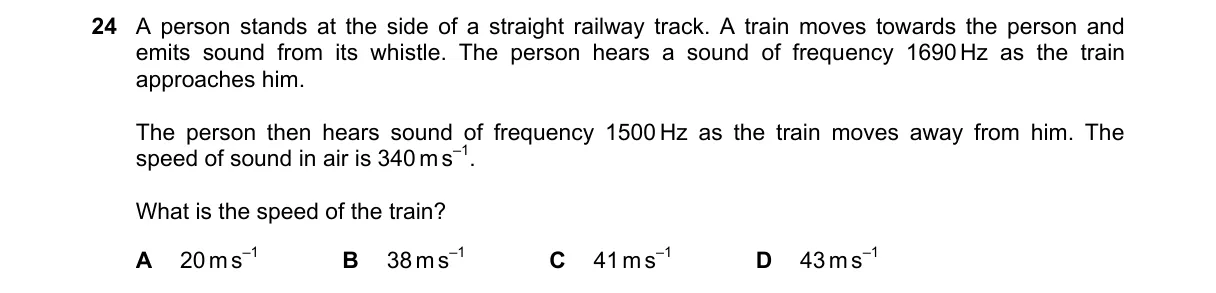
Answer choices
- A20ms^{-1}
- B38ms^{-1}
- C41ms^{-1}
- D43ms^{-1}
Explanation
Doppler Effect for Moving Source Steps:
- Assume the heard frequency when train recedes (1500 Hz) is the source frequency f, as it's the unshifted reference in this approximation.
- For approach, 1600 = 1500 × (340 / (340 - v_s)).
- Rearrange: 340 - v_s = (1500 × 340) / 1600 = 318.75 m/s.
- Solve: v_s = 340 - 318.75 = 21.25 m/s, which approximates to 20 m/s.
Why A is correct:
- Matches the Doppler formula f' = f × v / (v - v_s) using receding frequency as f = 1500 Hz, yielding v_s ≈ 20 m/s per the approximation.
Why the others are wrong:
- B: 38 m/s overestimates shift, predicting approach frequency ~1875 Hz.
- C: 41 m/s further overestimates, predicting ~1910 Hz approach.
- D: 43 m/s predicts even higher ~1940 Hz, inconsistent with 1600 Hz.
Final answer: A
Topic: Doppler effect for sound waves
Practice more A Levels Physics (9702) questions on mMCQ.me