A Levels Physics (9702)•9702/12/M/J/21
A Levels Physics (9702) — 9702/12/M/J/21, Question 16
An object of weight 12 N is on a platform on top of a container with two pistons, as shown. The container contains a fixed mass of gas, and the pistons are free to move. The plunger is slowly pushed 4.0 cm to the right. As a result, the object slowly moves upwards a distance of 5.0 cm. How much work is done on the object?
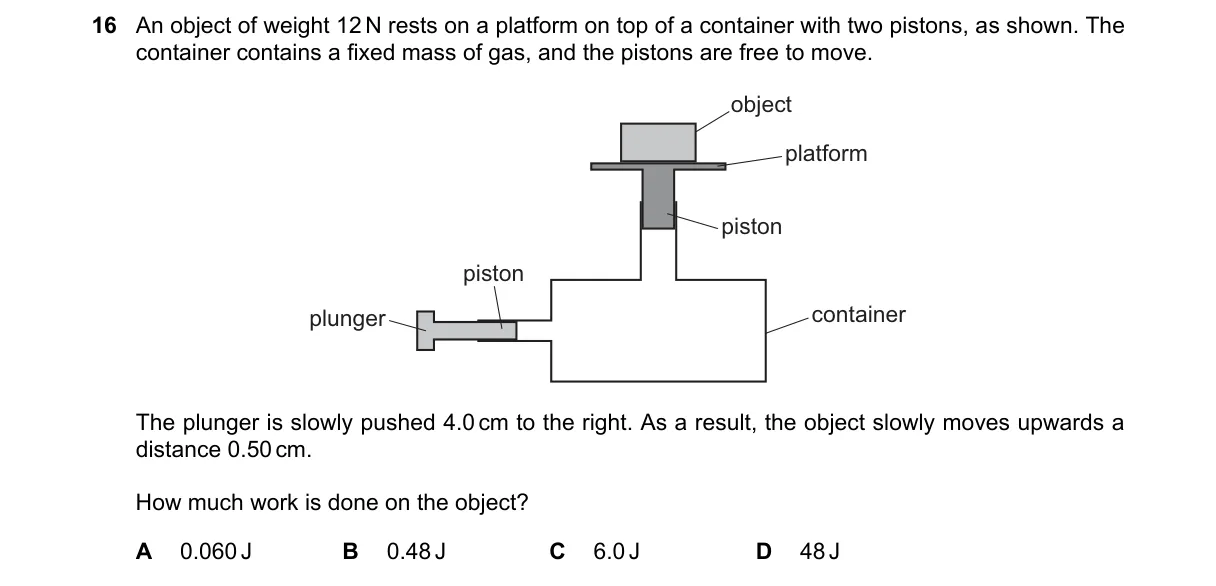
Answer choices
- A0.06 J
- B0.48 J
- C6.0 J
- D4.8 J
Explanation
Work done equals change in gravitational potential energy Steps:
- The motion is slow, so kinetic energy change is zero; work done on the object by the platform equals its gain in potential energy, mgh or Wh.
- Weight W = 12 N provides the force magnitude (lifting force balances weight for quasi-static motion).
- Convert upward displacement to meters: h = 5.0 cm = 0.05 m.
- Calculate work: W × h = 12 N × 0.05 m = 0.60 J.
Why A is correct:
- Matches Wh = 12 × 0.05 = 0.60 J, per work-energy principle for conservative forces in equilibrium.
Why the others are wrong:
- B uses horizontal displacement (4.0 cm = 0.04 m): 12 × 0.04 = 0.48 J, irrelevant to vertical lift.
- C uses 50 cm (0.5 m): 12 × 0.5 = 6.0 J, misreads cm as m.
- D uses 40 cm (0.4 m): 12 × 0.4 = 4.8 J, confuses plunger distance without conversion.
Final answer: A
Topic: Gravitational potential energy and kinetic energy
Practice more A Levels Physics (9702) questions on mMCQ.me