A Levels Physics (9702)•9702/12/M/J/21
A Levels Physics (9702) — 9702/12/M/J/21, Question 15
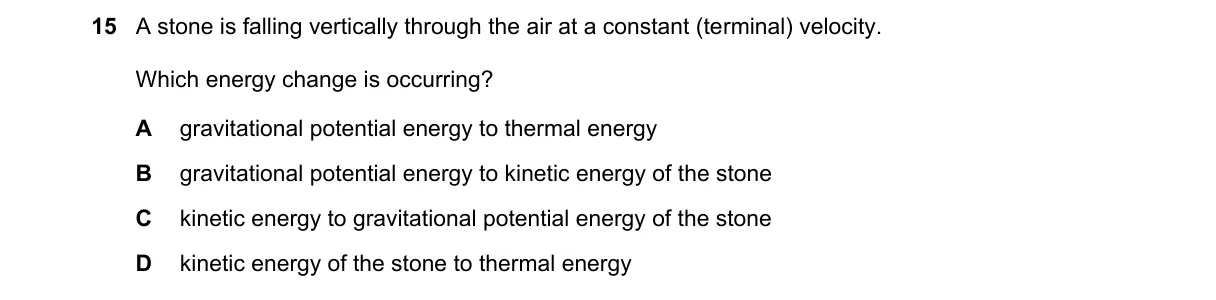
A stone is falling vertically through the air at constant (terminal) velocity. Which energy change occurs?
Answer choices
- Agravitational potential energy to thermal energy
- Bgravitational potential energy to kinetic energy
- Ckinetic energy to gravitational potential energy of the stone
- Dkinetic energy of the stone to thermal energy
Explanation
Energy conversion at terminal velocity
Steps:
- Terminal velocity means constant speed, so net force is zero and acceleration is zero.
- As the stone falls, its height decreases, converting gravitational potential energy (PE) to other forms.
- Kinetic energy (KE) remains constant due to unchanging velocity.
- Air resistance (drag) balances gravity, dissipating energy as thermal energy through friction.
Why A is correct:
- By the work-energy principle, decreasing PE equals work done against drag, which generates thermal energy per the first law of thermodynamics.
Why the others are wrong:
- B: KE stays constant, so PE does not convert to KE.
- C: Stone falls, decreasing PE, not increasing it from KE.
- D: KE remains constant, so it does not convert to thermal energy.
Final answer: A
Topic: Gravitational potential energy and kinetic energy
Practice more A Levels Physics (9702) questions on mMCQ.me