A Levels Physics (9702)•9702/12/M/J/21
A Levels Physics (9702) — 9702/12/M/J/21, Question 10
Nitrogen molecule P travelling at a speed of 320 m/s in vacuum collides with a stationary nitrogen molecule Q. After the collision, P travels at a velocity of 180 m/s at an angle of 55° to its original path. Q travels in a direction at an angle of 34° to the initial path of P. Assume that there are no external forces acting on the molecules. What is the magnitude of the velocity of Q after the collision?
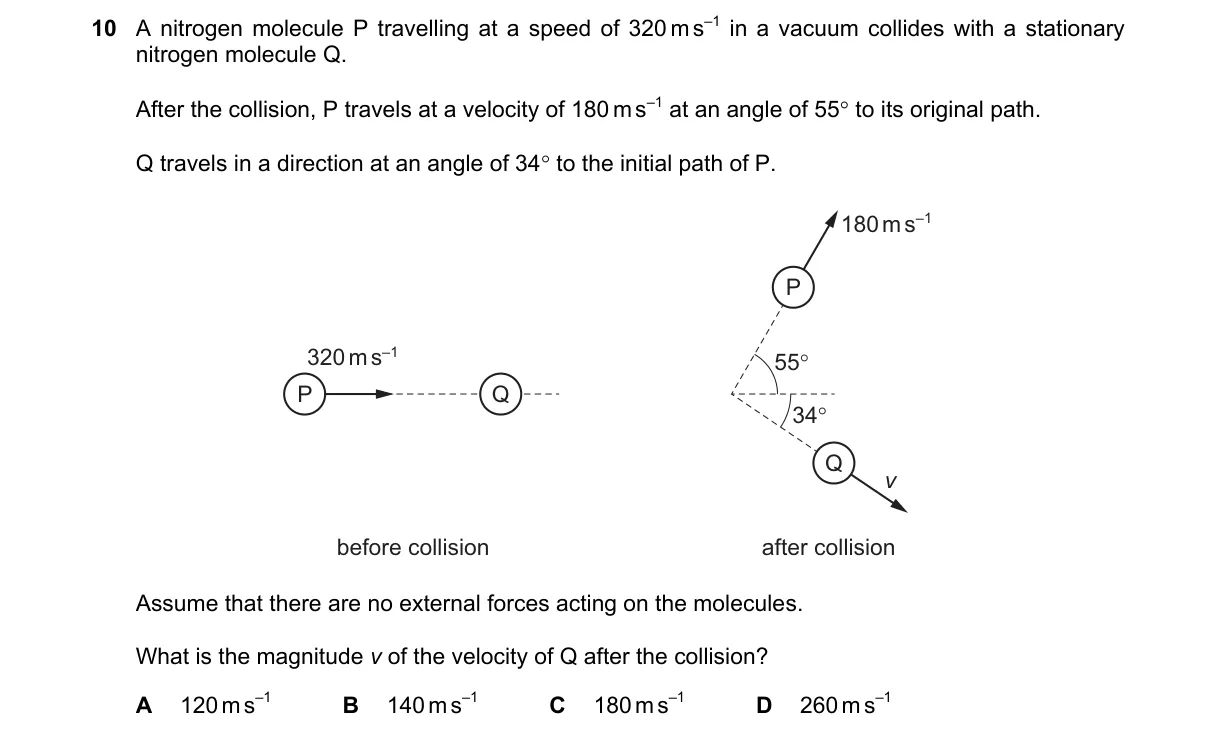
Answer choices
- A20 m/s
- B140 m/s
- C180 m/s
- D260 m/s
Explanation
Conservation of momentum in elastic collision of equal-mass molecules
Steps:
- Resolve post-collision velocities: P has vx = 180 cos 55° (x), vy = 180 sin 55° (y, positive); Q has vx = v cos 34° (x), vy = -v sin 34° (y, negative to balance).
- x-momentum: m × 320 = m (180 cos 55° + v cos 34°).
- y-momentum: 0 = m (180 sin 55° - v sin 34°), so v = 180 (sin 55° / sin 34°) ≈ 180 × (0.8192 / 0.5592) ≈ 264 m/s (≈260 m/s).
- Verify x: 180 cos 55° + 260 cos 34° ≈ 103 + 215 ≈ 318 m/s (matches 320 m/s within rounding).
Why D is correct:
- y-momentum conservation yields v ≈ 260 m/s directly from vector components and equal masses.
Why the others are wrong:
- A: Underestimates speed; fails to account for full y-component transfer.
- B: Possible error from using cos instead of sin ratios or ignoring y-direction.
- C: Equals P's post-speed but ignores momentum balance for Q.
Final answer: D
Topic: Linear momentum and its conservation
Practice more A Levels Physics (9702) questions on mMCQ.me