A Levels Physics (9702)•9702/11/M/J/21
A Levels Physics (9702) — 9702/11/M/J/21, Question 35
A cell is described as having electromotive force (e.m.f) of 6V. What does this mean?
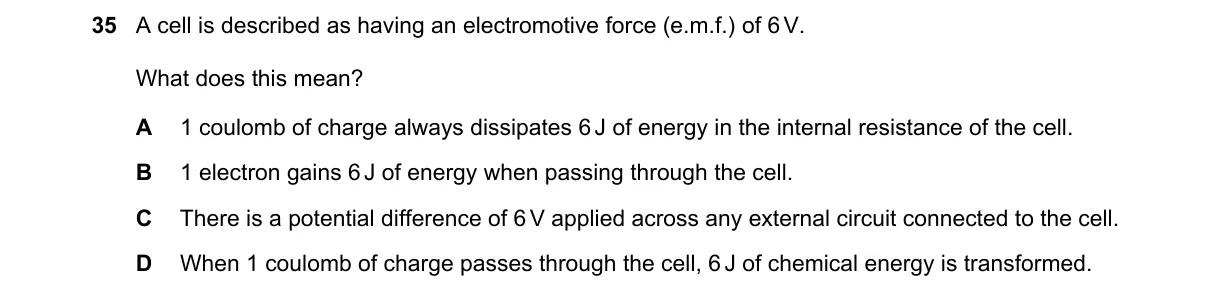
Answer choices
- A1 coulomb of charge always dissipates 6J of energy in the internal resistance of the cell.
- BThere is a potential difference of 6V across any external circuit connected to the cell.
- C1 coulomb of charge gains 6J of energy when passing through the cell.
- DWhen 1 coulomb of charge passes through the cell 6J of chemical energy is transformed.
Explanation
Electromotive Force as Energy per Unit Charge
Steps:
- Define e.m.f. as the work done by a cell to separate charges, measured in volts (joules per coulomb).
- Recognize that e.m.f. quantifies chemical energy converted to electrical energy per unit charge in the cell.
- Compare options to the definition: e.m.f. = ε = W/Q, where W is chemical work done on charge Q.
- Select the option matching this energy transformation process.
Why D is correct:
- E.m.f. is defined as the chemical energy transformed into electrical energy per coulomb of charge passing through the cell, so 6V means 6J per coulomb (ε = W/Q).
Why the others are wrong:
- A: Describes energy loss in internal resistance, which reduces terminal voltage but is not e.m.f.
- B: Refers to terminal potential difference under load, not the open-circuit e.m.f.
- C: Implies charge gains energy externally, but e.m.f. specifically involves internal chemical transformation, not just any gain.
Final answer: D
Topic: Potential difference and power
Practice more A Levels Physics (9702) questions on mMCQ.me