A Levels Physics (9702)•9702/11/M/J/21
A Levels Physics (9702) — 9702/11/M/J/21, Question 29
Light of a single unknown wavelength and blue light of a single wavelength are both incident normally on a diffraction grating. Two diffraction patterns are produced, one for each wavelength of light. The third-order maximum for the blue light occurs at the same angle as the second-order maximum for the unknown light. The wavelength of the blue light is 480 nm. What is the wavelength of the unknown?
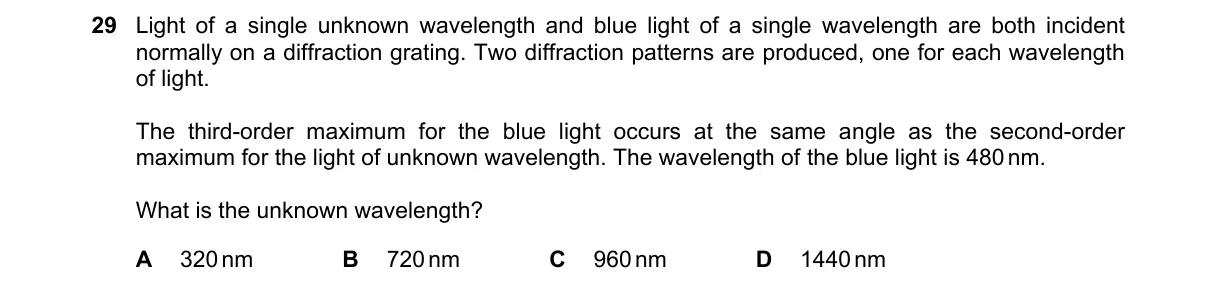
Answer choices
- A320 nm
- B720 nm
- C480 nm
- D1440 nm
Explanation
Diffraction grating equation equates orders and wavelengths at same angle
Steps:
- Use diffraction grating formula: d sinθ = mλ, where d is spacing, θ is angle, m is order, λ is wavelength.
- For same θ, m_blue λ_blue = m_unknown λ_unknown.
- Substitute values: 3 × 480 nm = 2 × λ_unknown.
- Solve: λ_unknown = (3 × 480) / 2 = 720 nm.
Why B is correct:
- 720 nm satisfies d sinθ = mλ, as 2 × 720 = 1440 equals 3 × 480, matching angles per grating law.
Why the others are wrong:
- A: 320 nm gives 2 × 320 = 640, not equal to 1440, so angles differ.
- C: 480 nm gives 2 × 480 = 960, not equal to 1440, so angles differ.
- D: 1440 nm gives 2 × 1440 = 2880, twice 1440, so angle is larger.
Final answer: B
Topic: The diffraction grating
Practice more A Levels Physics (9702) questions on mMCQ.me