A Levels Physics (9702)•9702/11/M/J/21
A Levels Physics (9702) — 9702/11/M/J/21, Question 22
A longitudinal wave travelling from left to right has vibrations parallel to the direction of transfer of the wave. The graph shows the particles from equilibrium positions at one instant with distance from the source. Which point on the graph is the centre of a compression?
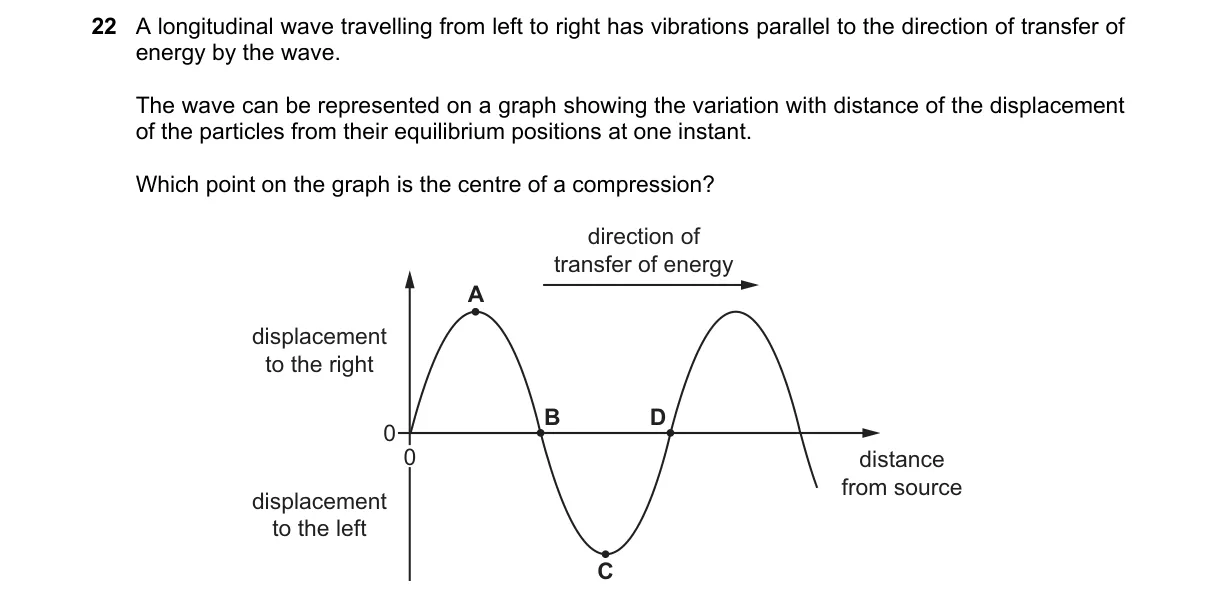
Answer choices
- AOption A
- BOption B
- COption C
- DOption D
Explanation
Identifying compression in longitudinal waves
Steps:
- Recall that in a longitudinal wave, compressions occur where particles are displaced towards each other, increasing density.
- Examine the graph: it plots particle displacement from equilibrium versus distance from the source at a fixed instant.
- Identify regions of maximum density: these are where adjacent particles have displacements that bring them closer together.
- Locate the center: it's the point of zero displacement midway between particles moving inward, indicating peak compression.
Why B is correct:
- Point B shows zero displacement at the midpoint of a region where particles on either side are displaced towards it, matching the definition of maximum density in a compression.
Why the others are wrong:
- A: Represents a rarefaction center, with particles displaced away, decreasing density.
- C: Lies on a positive displacement slope, indicating ongoing particle motion, not peak compression.
- D: Shows negative displacement, part of a rarefaction or antinode, not compression.
Final answer: B
Topic: Transverse and longitudinal waves
Practice more A Levels Physics (9702) questions on mMCQ.me