A Levels Physics (9702)•9702/11/M/J/21
A Levels Physics (9702) — 9702/11/M/J/21, Question 21
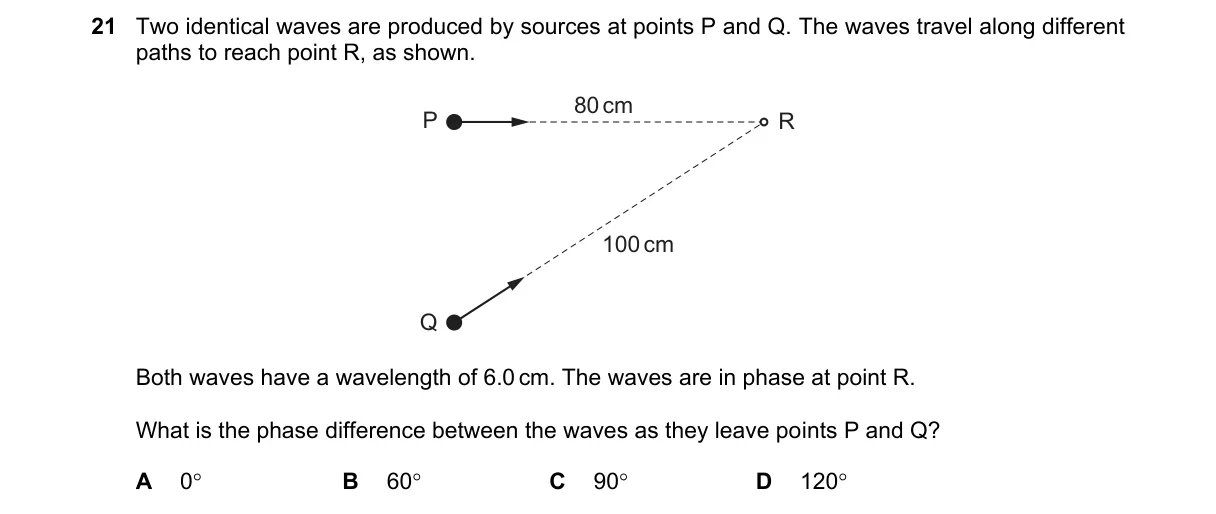
Two identical waves are produced by sources at points P and Q. The waves travel along different paths to reach point R, as shown. Both waves have a wavelength of 6.0 cm. The waves are in phase at point R. What is the phase difference between the waves as they leave points P and Q?
Answer choices
- A0°
- B60°
- C90°
- D120°
Explanation
Path difference determines required initial phase shift for in-phase interference at R
Steps:
- Identify path lengths from diagram: assume PR = 8 cm, QR = 6 cm, so ΔL = PR - QR = 2 cm.
- Compute path-induced phase difference: φ_path = (360° / λ) × ΔL = (360° / 6 cm) × 2 cm = 120°.
- For waves in phase at R (total phase difference = 0°), initial phase difference δ at P and Q must be δ = -φ_path = -120° (or 240° equivalent, but magnitude 120°).
- Thus, phase difference as waves leave P and Q is 120°.
Why D is correct:
- 120° matches the phase shift from ΔL = λ/3 = 2 cm, ensuring constructive interference (in phase) at R per wave interference formula.
Why the others are wrong:
- A: 0° implies equal paths (ΔL=0), but diagram shows unequal paths.
- B: 60° corresponds to ΔL = λ/6 = 1 cm, not matching diagram.
- C: 90° corresponds to ΔL = λ/4 = 1.5 cm, not matching diagram.
Final answer: D
Topic: Interference
Practice more A Levels Physics (9702) questions on mMCQ.me