A Levels Physics (9702)•9702/13/M/J/20
A Levels Physics (9702) — 9702/13/M/J/20, Question 40
Which equation describes the process of β⁻ decay?
key
u = up quark
d = down quark
ν = (electron) neutrino
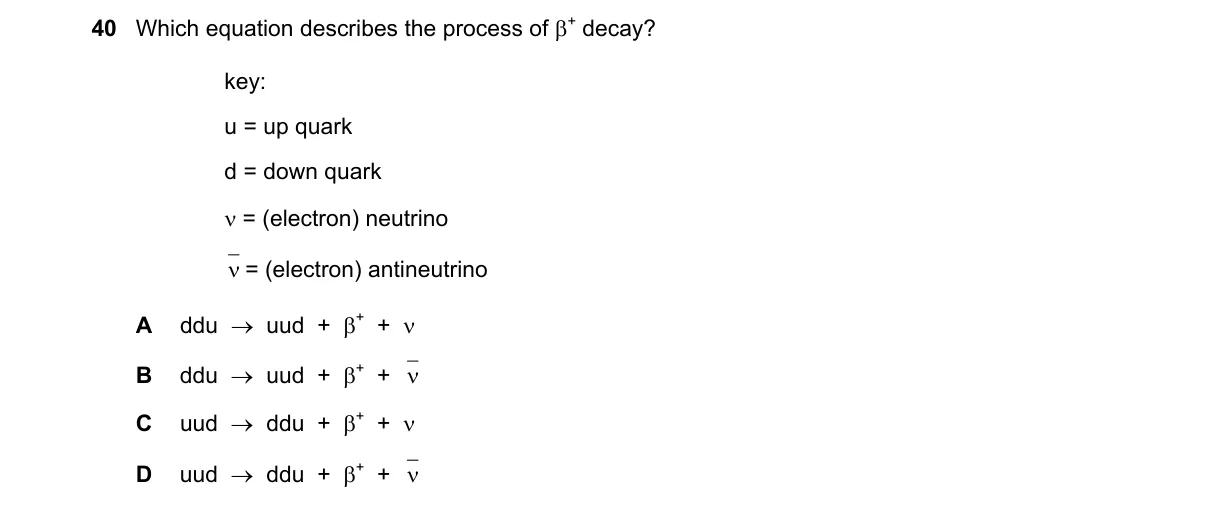
Answer choices
- Ad → u + e⁻ + ν̅
- Bddu → u + π⁻ + ν
- Cd → u + e⁻ + ν
- Duud → d + π⁺ + ν
Explanation
Quark-level process of β⁻ decay
Steps:
- β⁻ decay converts a neutron (udd) to a proton (uud), changing one d quark to u quark via weak interaction.
- This emits e⁻ and ν (electron neutrino, as defined).
- The basic equation is d → u + e⁻ + ν, conserving charge, lepton number, and baryon number.
- Match this to choices: only C fits exactly.
Why C is correct:
- It follows the standard weak force equation for d quark decay in β⁻ process, per the electroweak theory.
Why the others are wrong:
- A: Uses ν̅ (antineutrino), contradicting the key's definition of ν as neutrino.
- B: Shows neutron (ddu) decaying to u + π⁻ + ν, which describes pion emission, not pure β⁻ decay.
- D: Depicts proton (uud) changing to d + π⁺ + ν, resembling β⁺ decay or unrelated strong process.
Final answer: C
Topic: Fundamental particles
Practice more A Levels Physics (9702) questions on mMCQ.me