A Levels Physics (9702)•9702/13/M/J/20
A Levels Physics (9702) — 9702/13/M/J/20, Question 32
A negatively charged oil drop of mass m is between two horizontal parallel metal plates a distance d apart. When the potential difference between the plates is V, the oil drop rises at a constant speed. When the p.d. is decreased to a value between 0 and V, the oil drop falls at constant speed. Air resistance on the drop is negligible. Upthrust on the drop is negligible. What is the charge on the oil drop?
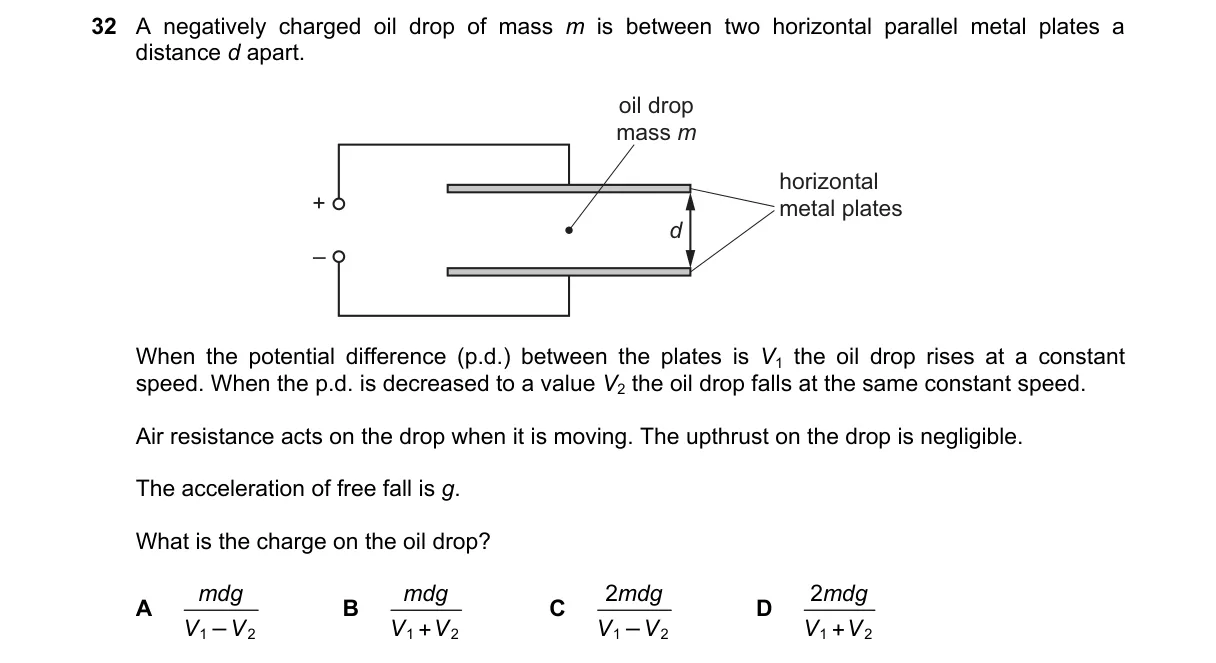
Answer choices
- A\frac{mg d}{V_1 - V_2}
- B\frac{mg d}{V_1 + V_2}
- C\frac{2 mg d}{V_1 - V_2}
- D\frac{2 mg d}{V_1 + V_2}
Explanation
Terminal velocity with equal drag forces
Steps:
- For rise at constant speed with V₁: q(V₁/d) = mg + F_d (electric up balances weight + drag down)
- For fall at constant speed with V₂: mg = q(V₂/d) + F_d (weight balances electric up + drag up)
- Add equations: q(V₁/d + V₂/d) = 2mg (drag terms cancel)
- Solve for charge: q = 2mg d / (V₁ + V₂)
Why D is correct:
- It derives from adding force balances, eliminating drag via superposition in opposite motions.
Why the others are wrong:
- A: Uses V₁ - V₂, which isolates 2F_d instead of charge.
- B: Lacks factor of 2, ignoring dual drag contributions.
- C: Combines factor of 2 with V₁ - V₂, yielding drag-related expression.
Final answer: D
Topic: Uniform electric fields
Practice more A Levels Physics (9702) questions on mMCQ.me