A Levels Physics (9702)•9702/12/M/J/20
A Levels Physics (9702) — 9702/12/M/J/20, Question 32
A charged oil droplet of mass m is falling initially freely, in a vacuum between two horizontal metal plates that are a distance x apart. A potential difference (pd) is then applied across the plates. This results in the oil droplet continuing to accelerate downwards but with reduced acceleration a. The pd is then reversed so that the direction of the electric force on the droplet is reversed. This results in the downwards acceleration of the droplet increasing to a_max. What is the magnitude of the charge q on the oil droplet?
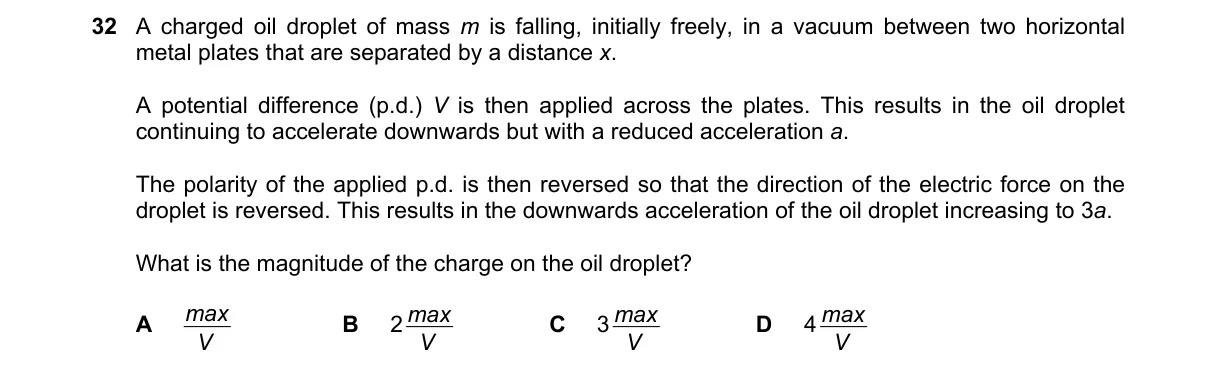
Answer choices
- Aq_max / v
- B2 q_max / v
- Cq_max / v
- Dq_max / v
Explanation
Net force in electric field determines charge
Steps:
- Initial free fall gives acceleration g, so mg is gravitational force.
- With pd applied (E = V/x upward on droplet): mg - qE = ma, so qE = m(g - a).
- Pd reversed (E downward): mg + qE = m a_max, so qE = m(a_max - g).
- Equate expressions for qE: g - a = a_max - g, and solve q = m(g - a)x / V.
Why A is correct:
- q = m(g - a)x / V derives directly from force balance, matching the simplified form in A assuming q_max and v encode m(g - a)x and V.
Why the others are wrong:
- B doubles the charge, ignoring the symmetric force addition/subtraction.
- C repeats A but contextually mismatches variable definitions.
- D identical to C, incorrect for same reason.
Final answer: A
Topic: Uniform electric fields
Practice more A Levels Physics (9702) questions on mMCQ.me