A Levels Physics (9702)•9702/12/M/J/20
A Levels Physics (9702) — 9702/12/M/J/20, Question 16
A spring is attached at one end to a fixed point. A mass is then hung from the other end of the spring. The spring is at extension x when the system is in equilibrium. The variation of the tension in the spring with its extension is shown on the graph. Which statement is correct?
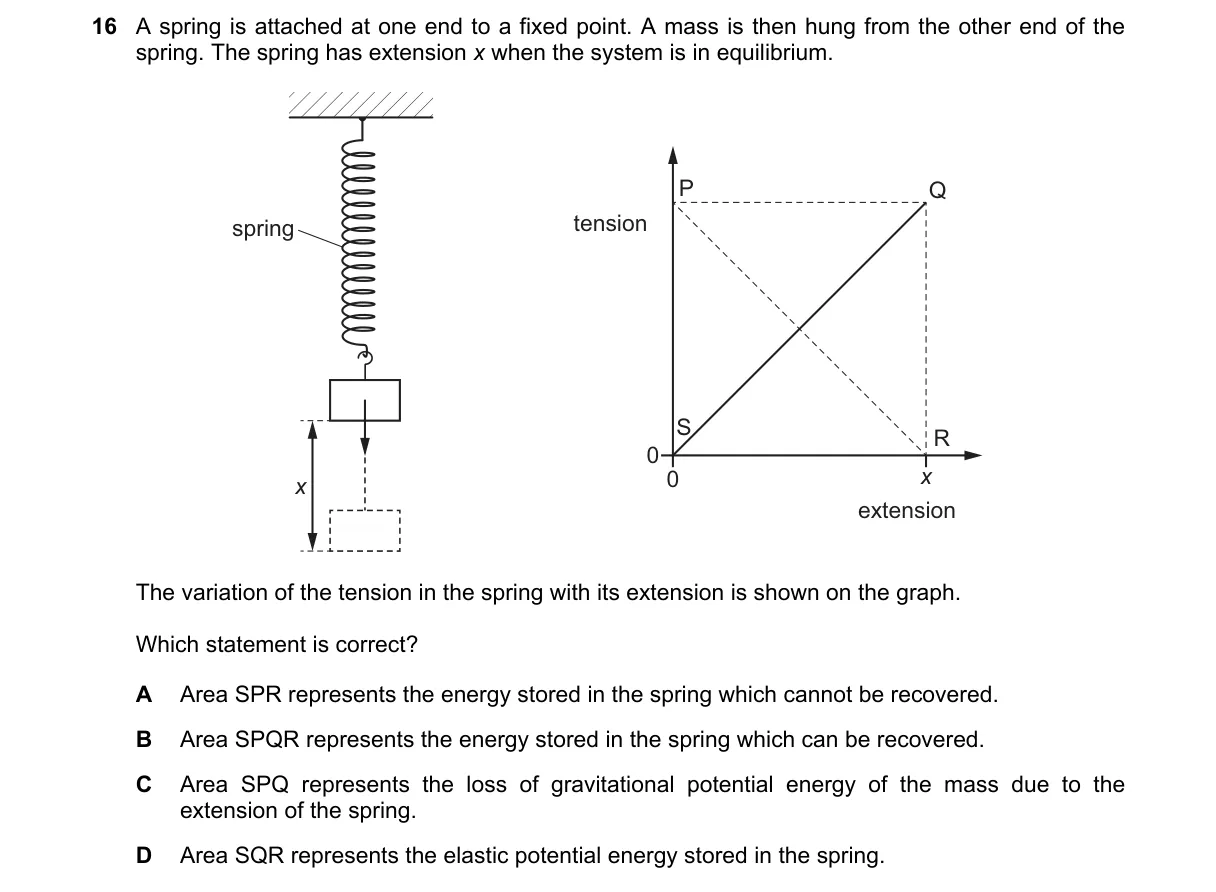
Answer choices
- AArea SPR represents the energy stored in the spring which can be recovered.
- BArea SPQ represents the loss of gravitational potential energy of the mass due to the extension of the spring.
- CArea SOR represents the elastic potential energy stored in the spring.
- DArea SQR represents the energy stored in the spring which cannot be recovered.
Explanation
Hysteresis in spring tension-extension graph Steps:
- Tension-extension graph for spring-mass shows loading (O to R) and unloading curves, with areas representing work and energy.
- Total work done by external force during extension equals area under loading curve (elastic PE stored plus dissipated).
- Energy recovered during unloading equals area under unloading curve.
- Difference (hysteresis loop area SQR) is irrecoverable energy lost to heat or deformation.
Why D is correct:
- Area SQR is the hysteresis loop, representing dissipated energy per Hooke's law extension with non-ideal behavior, which cannot be recovered as elastic potential.
Why the others are wrong:
- A: Area SPR includes part of loading curve but overstates recoverable energy, ignoring hysteresis losses.
- B: Area SPQ may approximate work against gravity (mgx), but loss of GPE is simply mgx, not tied to this specific area.
- C: Area SOR under loading curve includes both stored and lost energy, so not purely elastic potential.
Final answer: D
Topic: Elastic and plastic behaviour
Practice more A Levels Physics (9702) questions on mMCQ.me