A Levels Physics (9702)•9702/11/M/J/20
A Levels Physics (9702) — 9702/11/M/J/20, Question 38
In the circuit shown, a battery of negligible internal resistance is connected in series with a pair of fixed resistors R1 and R2. The circuit is to be used to test whether the X and Y terminals of a particular cell of e.m.f. 1.5 V. The cell is to be connected between terminals X and Y in parallel with R1 and in series with a galvanometer. Which statement about the test is correct?
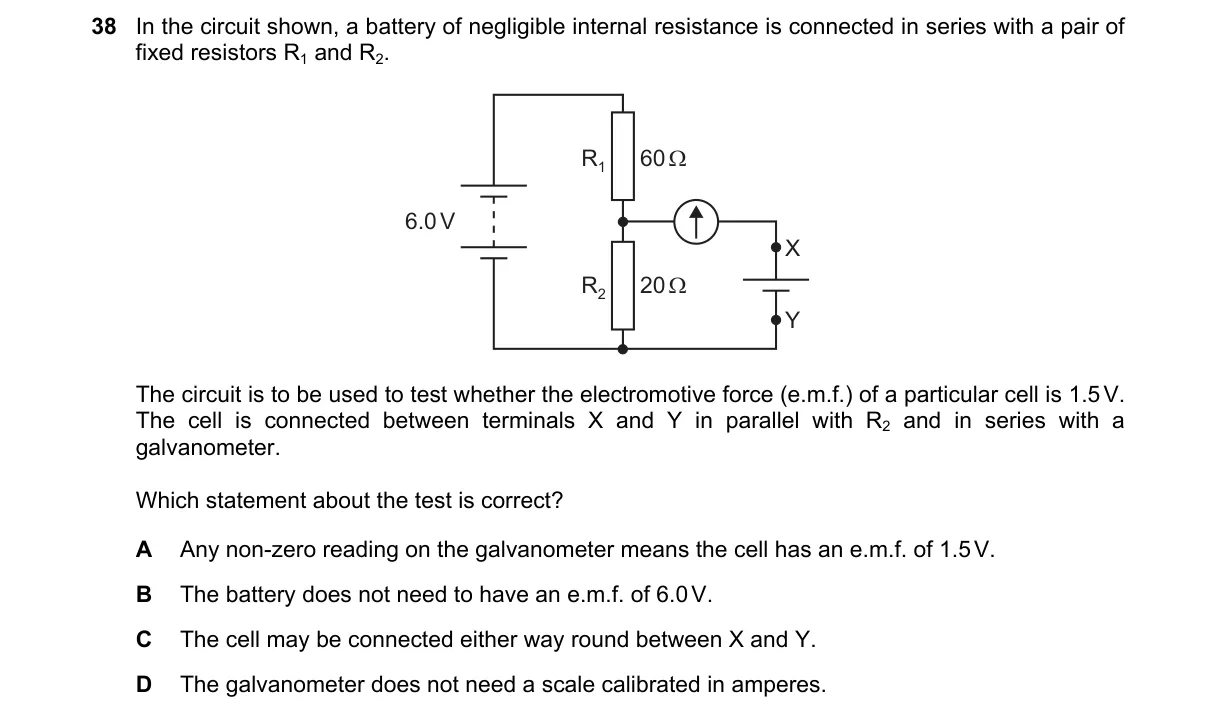
Answer choices
- AAny zero reading on the galvanometer means the cell has an e.m.f. of 1.5 V.
- BThe battery does not need to have an e.m.f. of 6.0 V.
- CThe cell may be connected either way around between X and Y.
- DThe galvanometer does not need a scale calibrated in amperes.
Explanation
Potentiometer null test for cell e.m.f. Steps:
- Battery drives current through series R1 and R2, creating potential difference V_{R1} = E \times R1/(R1 + R2) across R1, set to 1.5 V if E = 6.0 V.
- Test cell connects across X-Y (parallel to R1) with galvanometer in series, opposing V_{R1}.
- Zero galvanometer deflection occurs when cell e.m.f. equals V_{R1} with matching polarity, confirming no branch current.
- Galvanometer detects balance qualitatively via null point.
Why D is correct:
- Galvanometer acts as null detector in potentiometer method (Kirchhoff's law: zero current when voltages balance), needing only zero-deflection indication, not ampere calibration.
Why the others are wrong:
- A: Zero reading means cell e.m.f. equals V_{R1}, which is 1.5 V only if battery e.m.f. is 6.0 V; otherwise indicates different value.
- B: Battery requires 6.0 V e.m.f. to produce 1.5 V across R1 with fixed R1, R2 for the test.
- C: Reverse connection adds e.m.f. to V_{R1}, causing deflection; correct opposition polarity needed for balance.
Final answer: D
Topic: Potential dividers
Practice more A Levels Physics (9702) questions on mMCQ.me