A Levels Physics (9702)•9702/11/M/J/20
A Levels Physics (9702) — 9702/11/M/J/20, Question 36
A cell of electromotive force (emf) E and internal resistance r is connected to a resistor of resistance R. The maximum power P can be dissipated by the resistor without overheating. What is the maximum value of E if the resistor does not overheat?
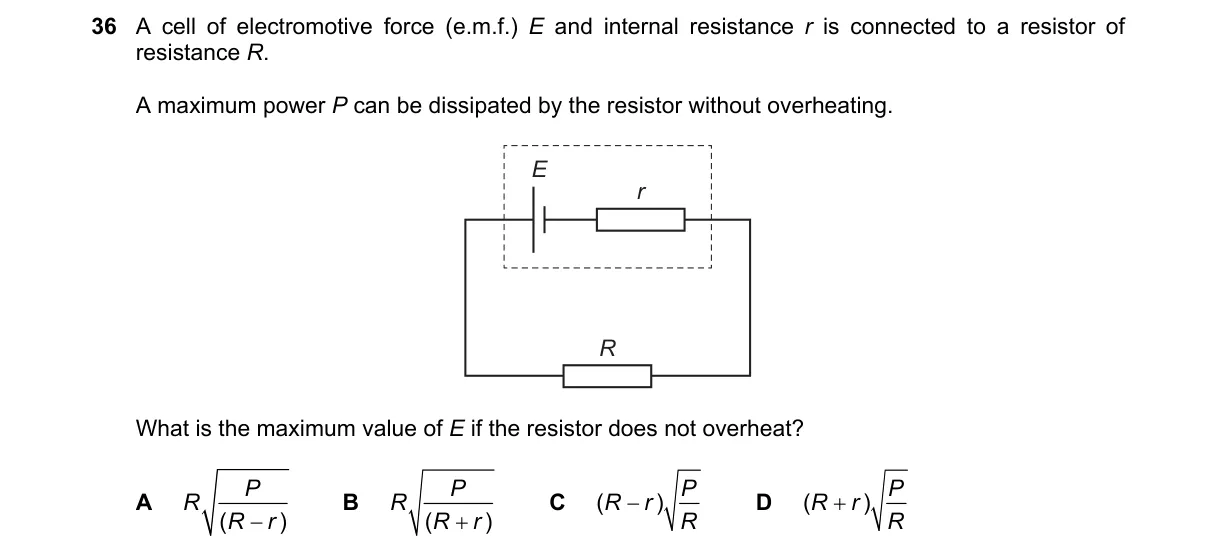
Answer choices
- A\sqrt{\frac{P}{R - r}}
- B\sqrt{\frac{P}{R + r}}
- C(R - r) \sqrt{\frac{P}{R}}
- D\frac{R \sqrt{P}}{R + r}
Explanation
Power dissipation formula for external resistor
Steps:
- Current I = E / (R + r).
- Power P = I² R = E² R / (R + r)².
- Rearrange: E² = P (R + r)² / R.
- Maximum E = (R + r) √(P / R).
Why D is correct:
- Matches the solved formula E = \frac{R \sqrt{P}}{R + r} from rearranging P = \frac{E^2 R}{(R + r)^2} under maximum safe power condition.
Why the others are wrong:
- A assumes R > r for defined value but ignores correct total resistance.
- B derives from total circuit power, not load power.
- C uses R - r, invalid for series circuit.
Final answer: D
Topic: Practical circuits
Practice more A Levels Physics (9702) questions on mMCQ.me