A Levels Physics (9702)•9702/11/M/J/20
A Levels Physics (9702) — 9702/11/M/J/20, Question 22
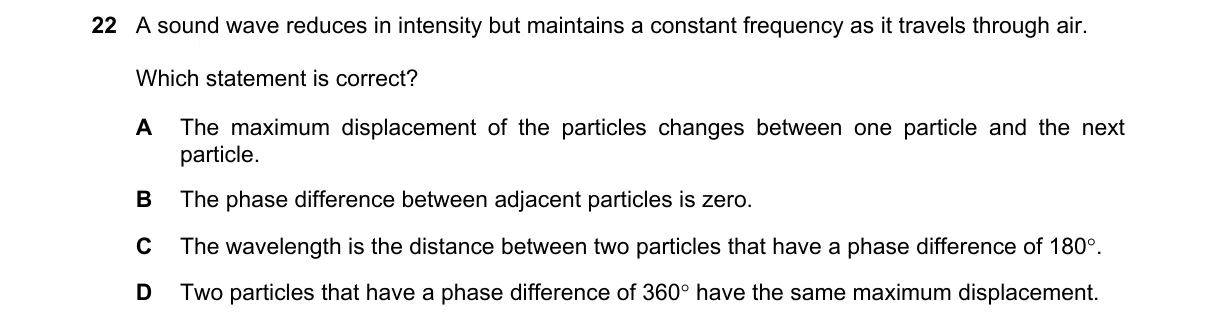
A sound wave reduces in intensity but maintains a constant frequency as it travels through air. Which statement is correct?
Answer choices
- AThe maximum displacement of the particles changes between one particle and the next
- BThe phase difference between adjacent particles is zero.
- CThe wavelength is the distance between two particles that have a phase difference of 180°.
- DTwo particles that have a phase difference of 360° have the same maximum displacement.
Explanation
Amplitude variation in attenuating sound waves
Steps:
- Intensity I is proportional to amplitude squared (I ∝ A²); decreasing I means A decreases with propagation distance.
- Constant frequency f keeps wavelength λ constant, since λ = v/f and speed v is fixed in air.
- Wave spreading or absorption causes A to vary continuously along the direction of travel.
- Thus, maximum particle displacement (A) differs slightly between adjacent particles separated along the propagation path.
Why A is correct:
- Decreasing intensity requires amplitude to decrease with distance, so maximum displacement varies between particles at successive positions, per the inverse square law for spherical waves.
Why the others are wrong:
- B: Adjacent particles along propagation have a small non-zero phase difference of (2π/λ) × separation distance.
- C: Wavelength λ is the distance for a 360° phase difference; 180° corresponds to λ/2.
- D: 360° phase difference means particles are in phase, but at different distances they have different amplitudes due to attenuation.
Final answer: A
Topic: Progressive waves
Practice more A Levels Physics (9702) questions on mMCQ.me