A Levels Physics (9702)•9702/11/M/J/20
A Levels Physics (9702) — 9702/11/M/J/20, Question 21
A tensile force is applied to an unstretched rubber band, causing it to stretch. The tensile force is then removed. Which statement about the rubber band must be correct?
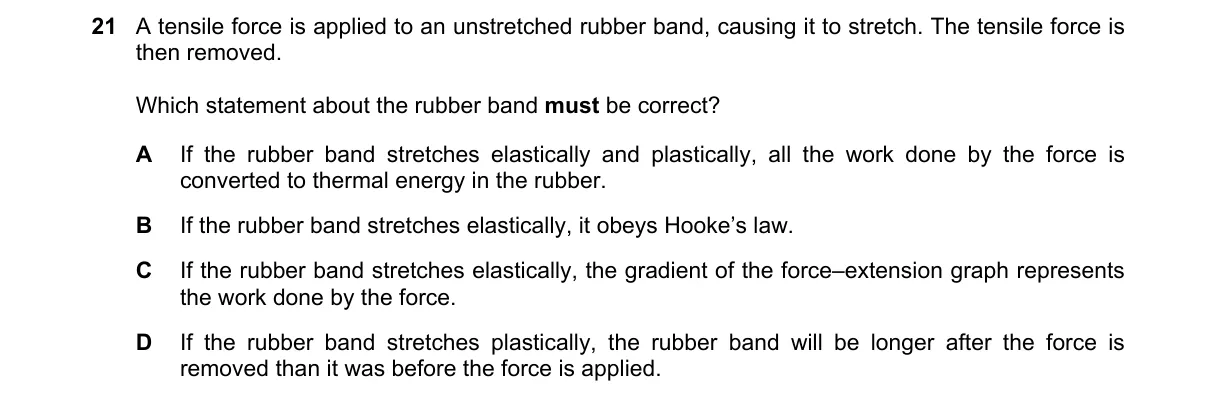
Answer choices
- AIf the rubber band stretches elastically, all the work done by the force is converted to thermal energy in the rubber.
- BIf the rubber band stretches elastically, it obeys Hooke's law.
- CIf the rubber band stretches plastically, the gradient of the force-extension graph represents
- DIf the rubber band stretches plastically, the rubber band will be longer after the force is removed than it was before the force is applied.
Explanation
Elastic vs. Plastic Deformation in Rubber Bands
Steps:
- Elastic deformation returns the material to original shape upon force removal, storing work as elastic potential energy.
- Plastic deformation causes permanent shape change, as atomic bonds break and reform in new positions.
- For rubber bands, stretching can be elastic (reversible) or plastic (irreversible) depending on force magnitude.
- Removing force after plastic stretch leaves residual extension, distinguishing it from elastic behavior.
Why D is correct:
- Plastic deformation, by definition, results in permanent strain, so the length remains greater than original after unloading.
Why the others are wrong:
- A: Elastic stretching stores work as potential energy, recoverable upon unloading, not fully converted to thermal energy.
- B: Elastic deformation is reversible but not always linear, so it does not necessarily obey Hooke's law (F = kx).
- C: The gradient (slope) represents stiffness or Young's modulus in the elastic region, not plastic where behavior is nonlinear.
Final answer: D
Topic: Elastic and plastic behaviour
Practice more A Levels Physics (9702) questions on mMCQ.me