A Levels Physics (9702)•9702/11/M/J/20
A Levels Physics (9702) — 9702/11/M/J/20, Question 11
A wooden block rests on the rough surface of a board. One end of the board is raised until the block slides down the board at constant velocity v. What describes the forces acting on the block when sliding with constant velocity?
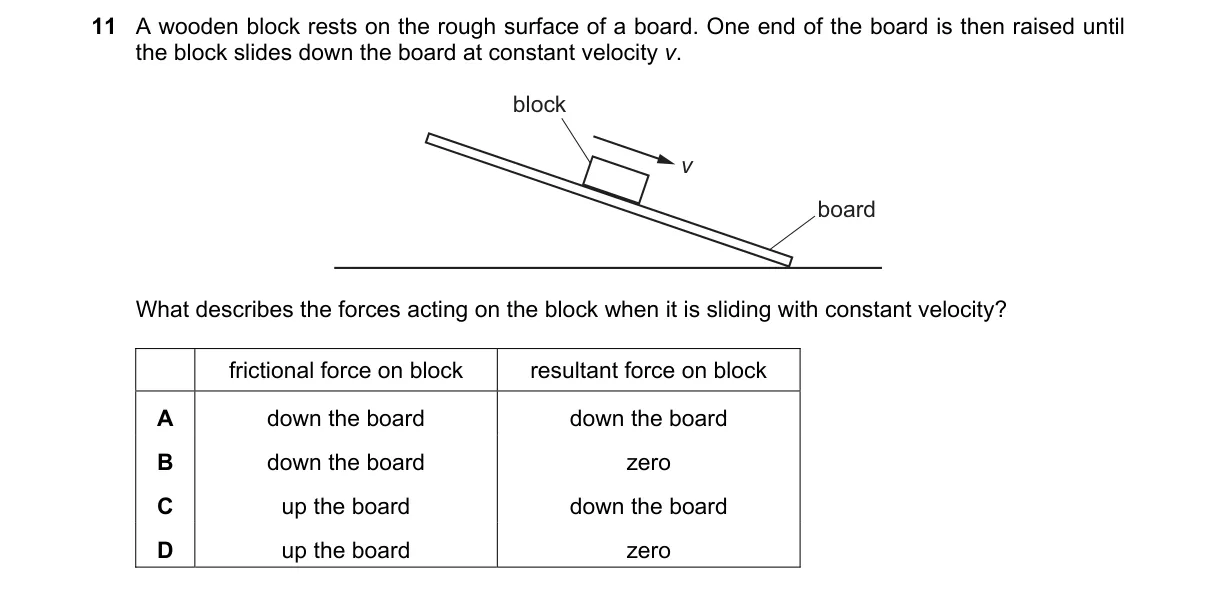
Answer choices
- Africtional force on the block down the board, resultant force on the block down the board
- Bfrictional force on the block up the board, resultant force on the block zero
- Cfrictional force on the block down the board, resultant force on the block zero
- Dfrictional force on the block up the board, resultant force on the block down the board
Explanation
Constant Velocity Implies Zero Net Force
Steps:
- Identify motion: Block slides down incline at constant velocity, so acceleration is zero along the board.
- Resolve forces: Gravity component down the board is mg sin θ; normal force perpendicular; kinetic friction opposes motion, so up the board with magnitude μ N = μ mg cos θ.
- Apply Newton's second law: For constant velocity, net force along board is zero, so friction up equals mg sin θ down.
- Direction check: Friction acts up the board to oppose downward slide; resultant force is zero.
Why B is correct:
- Newton's first law states that constant velocity requires zero resultant force; friction up the board balances the gravitational component down.
Why the others are wrong:
- A: Friction opposes motion (up, not down); resultant zero, not down.
- C: Friction up, not down; resultant zero is right but friction direction wrong.
- D: Resultant down would cause acceleration, violating constant velocity.
Final answer: B
Topic: Equilibrium of forces
Practice more A Levels Physics (9702) questions on mMCQ.me