A Levels Physics (9702)•9702/13/M/J/19
A Levels Physics (9702) — 9702/13/M/J/19, Question 36
A student has a set of identical cells and identical lamps. The cells have negligible internal resistance. A lamp connected to a cell lights with normal brightness. Only lamp 1 lights with normal brightness. What happens when the student connects the lamps and the cells as shown?
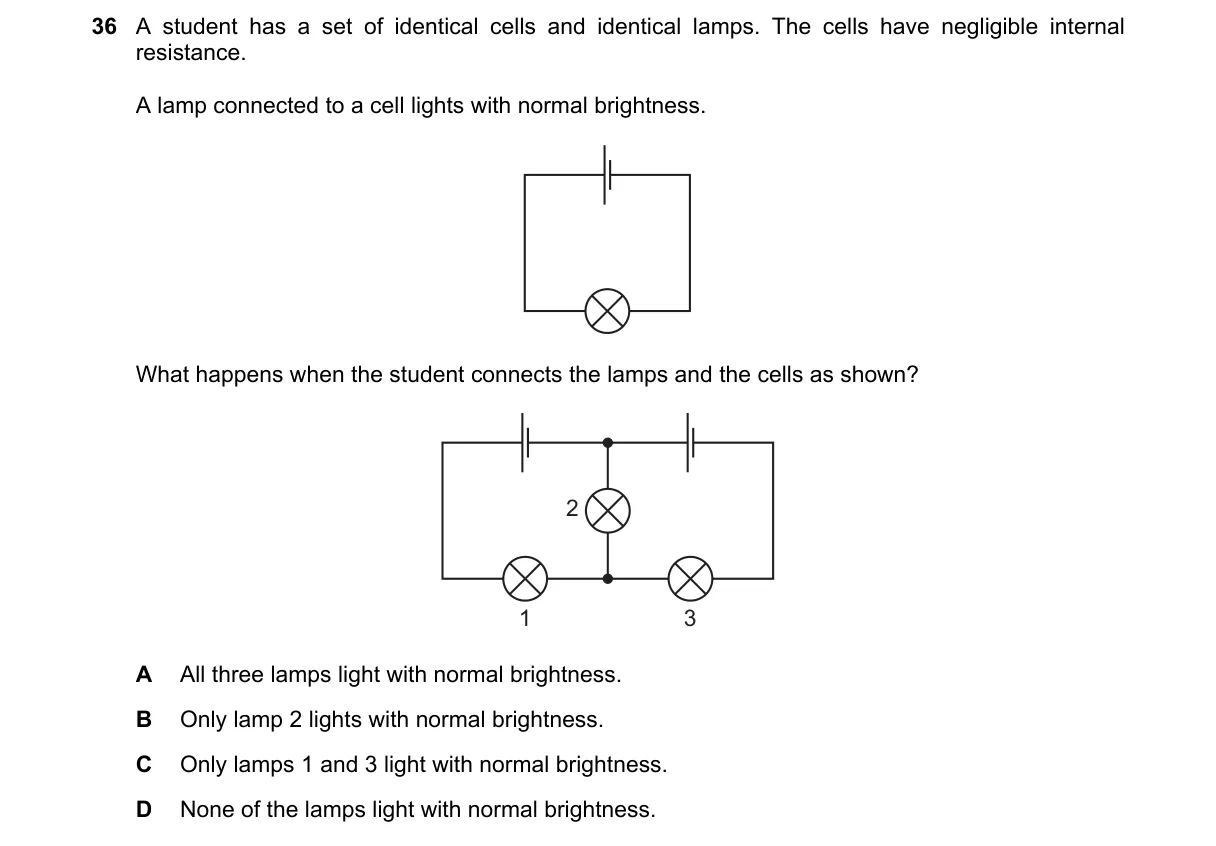
Answer choices
- AAll three light with normal brightness.
- BOnly lamps 1 and 2 light with normal brightness.
- COnly lamps 2 and 3 light with normal brightness.
- DNone of the lamps light with normal brightness.
Explanation
Circuit voltage distribution Steps:
- Assume two identical cells in series, providing total emf 2E.
- Lamp 1 connects across both cells, receiving voltage 2E.
- Lamp 2 connects across the first cell, receiving voltage E.
- Lamp 3 connects across the second cell, receiving voltage E. Why C is correct:
- Lamps 2 and 3 each get full emf E; by Ohm's law, V = IR yields normal current I = E/R for brightness. Why the others are wrong:
- A: Lamp 1 gets 2E, so brighter than normal.
- B: Lamp 1 gets 2E (brighter), not normal.
- D: Lamps 2 and 3 get E, so normal brightness. Final answer: C
Topic: Practical circuits
Practice more A Levels Physics (9702) questions on mMCQ.me