A Levels Physics (9702)•9702/13/M/J/19
A Levels Physics (9702) — 9702/13/M/J/19, Question 33
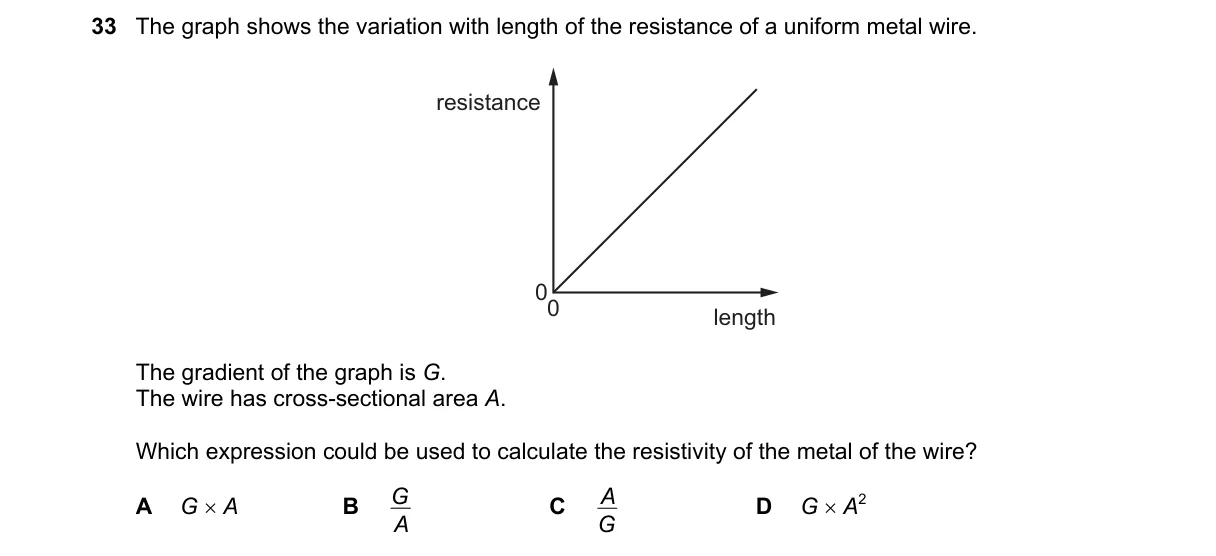
The graph shows the variation with length of the resistance of a uniform metal wire. The gradient of the graph is G. The wire has cross-sectional area A. Which expression could be used to calculate the resistivity of the metal wire?
Answer choices
- AG × A
- BA
- CG
- DG × A²
Explanation
Resistivity from slope of R-L graph
Steps:
- Resistance R of a wire is given by R = ρ L / A, where ρ is resistivity, L is length, and A is cross-sectional area.
- The graph plots R versus L for a uniform wire, so the gradient G equals the slope ΔR/ΔL.
- From the formula, G = ρ / A.
- Rearrange to solve for ρ: ρ = G × A.
Why A is correct:
- The formula R = ρ L / A rearranges to ρ = (R/L) A, and G is the slope R/L.
Why the others are wrong:
- B. A: Gives only area, ignoring slope and material property ρ.
- C. G: Equals ρ/A, so misses multiplication by A.
- D. G × A²: Introduces extra A factor not in the formula.
Final answer: A
Topic: Resistance and resistivity
Practice more A Levels Physics (9702) questions on mMCQ.me