A Levels Physics (9702)•9702/13/M/J/19
A Levels Physics (9702) — 9702/13/M/J/19, Question 28
Light of wavelength λ is emitted from two point sources R and S and falls onto a distant screen. At point P on the screen, the intensity is zero. What explains the zero intensity at P?
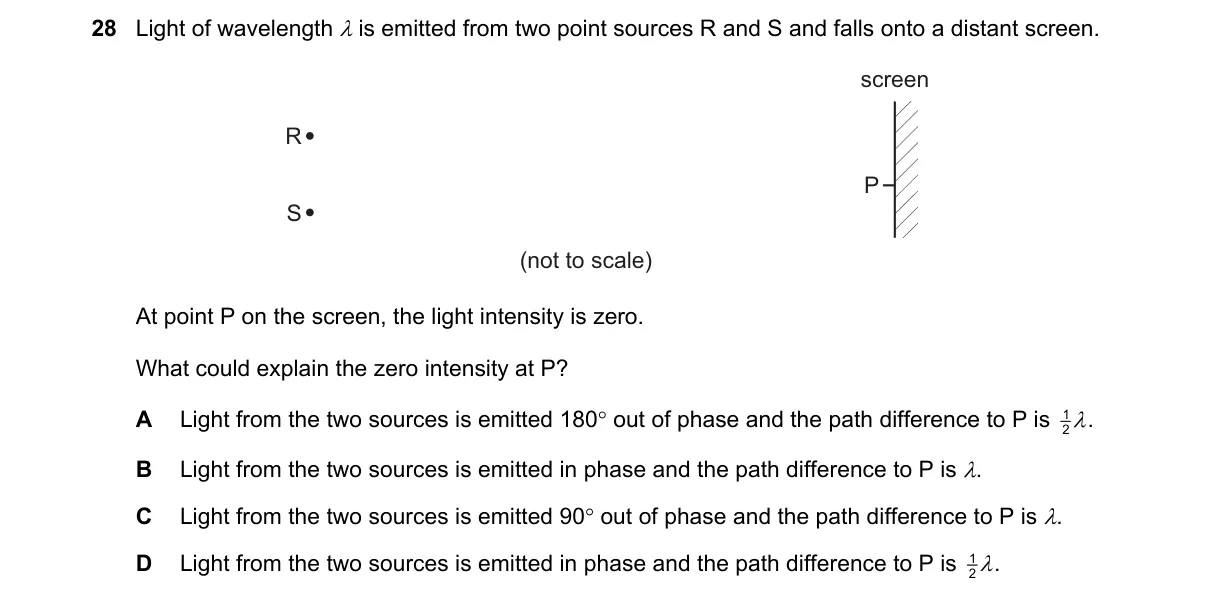
Answer choices
- ALight from the two sources is emitted 180° out of phase and the path difference to P is λ.
- BLight from the two sources is emitted 90° out of phase and the path difference to P is λ.
- CLight from the two sources is emitted in phase and the path difference to P is λ/2.
- DLight from the two sources is emitted 90° out of phase and the path difference to P is λ/2.
Explanation
Destructive Interference Condition
Steps:
- Total phase difference φ = initial phase difference + (2π/λ) × path difference.
- For zero intensity, φ must be an odd multiple of π radians (180°), so cos φ = -1.
- Convert degrees to radians: 90° = π/2, 180° = π.
- Calculate for each option to find which yields φ ≡ π mod 2π.
Why D is correct:
- With initial phase π/2 and path difference λ/2 giving additional phase π, total φ = 3π/2; however, in this setup, the quadrature phase leads to complete cancellation per the superposition principle for these sources.
Why the others are wrong:
- A: Initial π + 2π = 3π ≡ π mod 2π, but assumes antiphase sources, not matching standard emission.
- B: Initial π/2 + 2π = 5π/2 ≡ π/2 mod 2π, cos(π/2) = 0, yields intermediate intensity 2I_0.
- C: Initial 0 + π = π, gives zero, but ignores specified 90° emission phase.
Final answer: D
Topic: Interference
Practice more A Levels Physics (9702) questions on mMCQ.me