A Levels Physics (9702)•9702/13/M/J/19
A Levels Physics (9702) — 9702/13/M/J/19, Question 26
An elastic string is attached to an oscillator at one end and clamped at the other so that the string is horizontal and under tension. The oscillator is made to oscillate vertically. The frequency of oscillation is gradually increased from zero until a stationary wave is set up in the string. The frequency is then increased further. At which frequency does the string break?
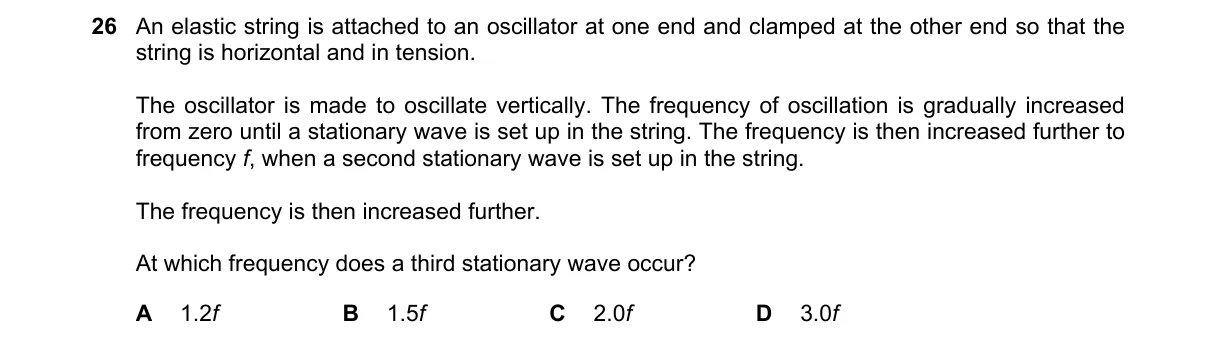
Answer choices
- A1/2 f
- B1 f
- C2.0 f
- D3 f
Explanation
String breaks at fundamental resonance due to maximum amplitude
Steps:
- First stationary wave forms at fundamental frequency f, with length L = λ/4 for driven-clamped string.
- Resonance at f maximizes transverse displacement amplitude for given driving force.
- Elastic string stretches more under large amplitude, increasing tension to breaking point.
- Beyond f, amplitude drops until next (odd) harmonic, preventing higher breaking risk.
Why B is correct:
- At fundamental f, maximum amplitude causes peak tension via elastic extension, per wave equation where A ∝ Q-factor at resonance.
Why the others are wrong:
- A: 1/2 f produces no standing wave, as below fundamental; insufficient amplitude for breaking.
- C: 2 f is even harmonic, absent in this boundary setup; no resonance, low amplitude.
- D: 3 f is higher odd harmonic with nodes reducing effective amplitude and tension.
Final answer: B
Topic: Stationary waves
Practice more A Levels Physics (9702) questions on mMCQ.me