A Levels Physics (9702)•9702/13/M/J/19
A Levels Physics (9702) — 9702/13/M/J/19, Question 16
A student can run up stairs to her classroom. Which statement describes the power required and the gravitational potential energy gained while running up the stairs compared to walking up them?
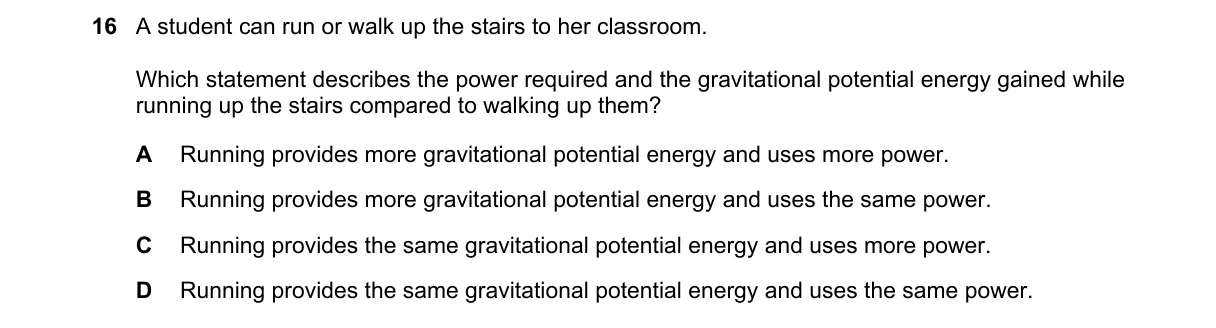
Answer choices
- ARunning provides more gravitational potential energy and uses more power.
- BRunning provides more gravitational potential energy and uses the same power.
- CRunning provides the same gravitational potential energy and uses more power.
- DRunning provides the same gravitational potential energy and uses the same power.
Explanation
Power Depends on Speed, Not Energy Gained
Steps:
- Gravitational potential energy (PE) gained equals mgh, where h is height; same stairs mean same h and m, so same PE for running or walking.
- Work done against gravity is identical in both cases, as it equals the PE change.
- Power is work done per unit time (P = W/t); running covers the height faster, reducing t.
- Thus, same work over less time means higher power for running.
Why C is correct:
- PE is mgh (independent of time), while power P = ΔPE/Δt increases for running due to shorter Δt.
Why the others are wrong:
- A: PE is the same, not more for running.
- B: PE is the same, and power is greater for running.
- D: Power is greater for running, not the same.
Final answer: C
Topic: Gravitational potential energy and kinetic energy
Practice more A Levels Physics (9702) questions on mMCQ.me