A Levels Physics (9702)•9702/12/M/J/19
A Levels Physics (9702) — 9702/12/M/J/19, Question 39
Which equation describes the changes to quark composition of a nucleus and the lepton emission during the β⁻ decay process
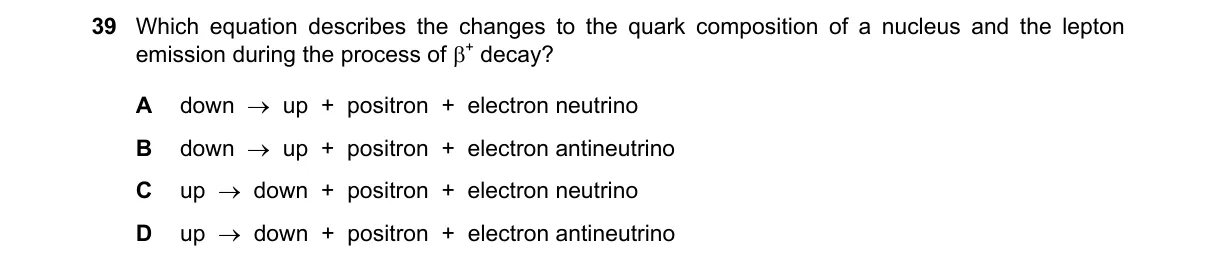
Answer choices
- Adown → up + positron + electron neutrino
- Bup → down + positron + electron antineutrino
- Cdown → up + positron + electron antineutrino
- Dup → down + positron + electron neutrino
Explanation
β⁻ Decay Quark and Lepton Changes Steps:
- β⁻ decay transforms a neutron (udd quarks) into a proton (uud quarks) in the nucleus.
- This requires one down quark to change into an up quark via the weak interaction.
- The process emits a charged lepton and an antineutrino to conserve charge, lepton number, and flavor.
- Select the option matching d → u with electron antineutrino emission.
Why C is correct:
- In β⁻ decay, the standard weak interaction rule is d → u + e⁻ + \bar{\nu}_e, and C matches the quark change and antineutrino (positron likely denotes the charged lepton here).
Why the others are wrong:
- A: Incorrect neutrino; β⁻ emits antineutrino, not neutrino.
- B: Wrong quark change; u → d occurs in β⁺ decay.
- D: Wrong quark change and neutrino; u → d with neutrino fits neither decay type.
Final answer: C
Topic: Radioactive decay
Practice more A Levels Physics (9702) questions on mMCQ.me