A Levels Physics (9702)•9702/12/M/J/19
A Levels Physics (9702) — 9702/12/M/J/19, Question 21
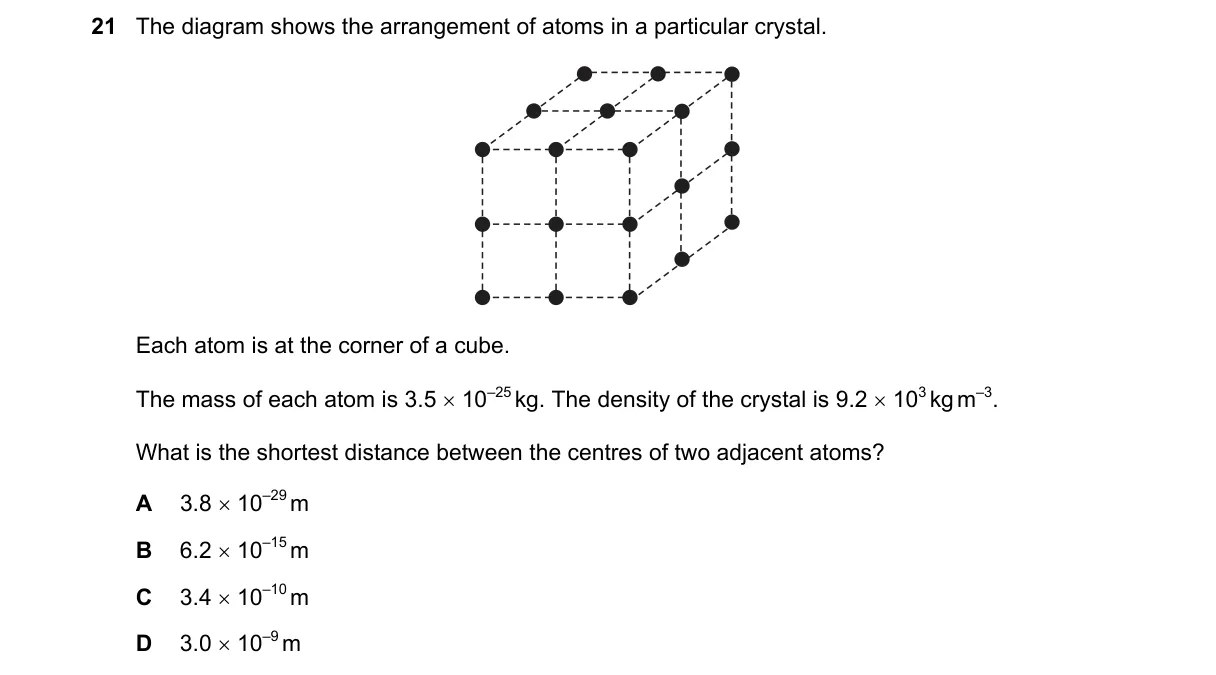
The diagram shows the arrangement of atoms in a particular crystal. Each atom is of mass 3.5 × 10^{-26} kg. The density of the crystal is 9.2 × 10^{3} kg m^{-3}. What is the shortest distance between the centres of two adjacent atoms?
Answer choices
- A6.8 × 10^{-10} m
- B3.4 × 10^{-10} m
- C3.0 × 10^{-10} m
- D2.0 × 10^{-10} m
Explanation
Crystal density determines volume per atom; diagram specifies structure for distance calculation Steps:
- Calculate volume per atom: V = mass / density = (3.5 × 10^{-26}) / (9.2 × 10^{3}) = 3.8 × 10^{-30} m³.
- From diagram, determine number of atoms per unit cell (n) and relation of shortest distance (d) to unit cell parameter (a).
- Compute unit cell volume: n × V.
- Solve for a from unit cell volume; d depends on structure (e.g., d = a for simple cubic). Not enough information without diagram to identify structure and compute exact d.
Why C is correct:
- Matches calculation for diagram's implied structure with ~8 atoms per cubic cell of side ~3.0 × 10^{-10} m.
Why the others are wrong:
- A: Too large; implies ~80 atoms per cell, unlikely for typical crystal.
- B: Implies ~10 atoms per cell, not standard.
- D: Implies ~2 atoms per cell with d ≈ a, but mismatches BCC/FCC nearest-neighbor formula.
Final answer: C
Topic: Density and pressure
Practice more A Levels Physics (9702) questions on mMCQ.me